Amicable ties emphasised as Philippines President Wraps Up Southeast Asia Trip
Originally aired on Channel NewsAsia on March 21, 2017
Here's my short Channel NewsAsia report on the visit by Philippines president Rodrigo Duterte at Bangkok's Government House today.
TRANSCRIPT
Thailand is the final destination of Philipines president Rodrigo Duterte's tour of Southeast Asia, as he arrived at Government House in Bangkok and is able finally make good on his promise to meet every leader in the region ever since he took office 8 months ago.
He was greeted by Thai Prime Minister General Prayuth Chan-ocha with military honors, before a delegation of both countries signed three MOUs to cooperate on a broad range of issues including science, technology, tourism and agriculture.
Both Mr. Prayuth and Mr. Duterte have emphasised the bilateral ties between the two countries and the pledge to continue with that going ahead.
[Rodrigo Duterte, President of the Philippines]
"With formal diplomatic relations for 67 years, we have [a] proven record of collaboration. We can and should rightfully strive to achieve more. As countries facing similar challenges, and as brothers in ASEAN, we have a joint stake in keeping our relations always vibrant"
[Gen. Prayuth Chan-ocha, Prime Minister of Thailand]
"And finally, as Thai-Philipino relations are entering the seventh decade, me and the president have ensured close cooperations to move forward our progress and prosperity of both our countries, its people, ASEAN and the region as a whole. Thank you."
Mr. Duterte will wrap up his Southeast Asia Tour on Wednesday as he is meeting with Thai business and with members of the local Philipino community, of which an estimated 16,000 people are living in Thailand.
Saksith Saiyasombut, Channel NewsAsia, Bangkok
"Safety Zones" To Be Established In Insurgent Deep South
Originally aired on Channel NewsAsia on March 17, 2017
Here's my short Channel NewsAsia report on the Thai government's deal with insurgent groups to estbalish 'safety zones' in the Deep South
Cobra Gold 2017: Are US-Thai Relations Improving?
My latest Channel NewsAsia report on the opening ceremony of Exercise Cobra Gold 2017 and the state of US-Thai military relations at the very beginning of Donald Trump's US presidency.
TRANSCRIPT
Around Valentine's Day for nearly four decades, the armed forces of Thailand and the United States come together for war games which actually demonstrate a healthy relationship between the two.
But that hasn't always been the case in recent years.
The relations between the United States and Thailand have been somewhat frosty since the military coup in 2014. The US has suspended millions of dollars in military aid and reduced its commitment to Exercise Cobra Gold. But this year, with the attendance of the highest-ranking US military officer in years, and the growing geo-strategic challenges in the Asia Pacific, the US may be slowly warming up to one of its longest-standing allies in the region.
This year's guest of honor, Admiral Harry B. Harris from the US Pacific Command, stressed the importance of a strong Thailand and the importance of restoring democracy in the country.
"The US alliance with Thailand is a deep and enduring commitment. We look forward to Thailand's reemergence as a flourishing democracy because we need Thailand as a strong and stable ally. We need Thailand to get back to be the regional and global leader that it always has been. We (missing word?) Thailand's leadership in Asia," he said during the opening ceremony.
Thailand, which was criticized by the previous US administration for the numerous delays in holding democratic elections, also opted for a conciliatory tone.
"The political issues remain political issues and The US have their (differing) opinion, but we have been training together for years and that's nothing special," said Gen. Surapong Suwana-Adth, the Chief of the Thai Defense Forces.
The affirmation of ties comes amid uncertainty about the role of the US in Asia with Mr Donald Trump as president.
But if the mood at this year's Cobra Gold is anything to go by, then at least military leaders from the US and Thailand are getting along fine.
The drills are the largest US-led military exercises in Asia.
This year, some 8,300 troops from nearly 30 countries are taking part in various combat exercises and humanitarian operations.
This includes personnel from Japan, South Korea, Indonesia, Singapore and Malaysia.
Saksith Saiyasombut, Channel NewsAsia, Sattahip, Chonburi province
Starting a new chapter
 After a short hiatus, I’m happy to finally announce that today I’m beginning my new job as Channel NewsAsia’s new IndoChina Correspondent based at their Bangkok Bureau. I’m excited to be back in the city and being back on the air reporting on country has changed a lot since my last stint, to say the least. There’ll be surely no shortage of stories to cover and developments to analyze. And last but not least, I’m looking forward to working my new and old colleagues!
There’ll be one or two small changes on my social media front: I will still have my own personal accounts (facebook.com/saksith.saiyasombut and @Saksith), but in addition I will also post all the stuff our Indochina Bureau produces on my ”work” accounts (facebook.com/Saiyasombut and @SaksithCNA), including our reports, when we go on air next, exclusive looks behind the scenes, Facebook live streams and other stuff down the line.
I’m super-stoked for this opportunity and I wanna thank those that have made it possible, you know who you are! Here’s to the new chapter - starting now!
Cheers,
Saksith Saiyasombut Channel NewsAsia IndoChina Correspondent
My final post for Asian Correspondent
After almost six years and nearly 400 articles, this is my last post at Asian Correspondent. Seriously. For real. It’s been quite a journey.
Unfolding and unscrambling the Thai military junta's policy advertorial

An advertisement supplement touting the polices of Thailand's military government appeared on the front page of the English-language newspaper The Nation on February 23, 2016. (Pic: Reader submission)
Originally published at Asian Correspondent on February 26, 2016
Thailand’s military government has gone on the media offensive to promote its "reform roadmap" by planting paid advertisement supplements in Thai newspapers. But the published product is, in its own words, one giant "confusion trap".
It is an uphill struggle the Thai military has faced ever since it took over in the coup of May 22, 2014 and almost two years later it has become increasingly Sisyphean. The battle over the sovereign narrative of the political discourse in Thailand is one of the biggest headaches for the "National Council for Peace and Order" (NCPO) – as the military junta formally calls itself.
Considering the restrictions by the junta to curtail any kind of criticism, be it by online censorship, aggressive behavior towards the media (also increasingly against foreign media) and the detainment and harassment of dissidents, the generals have a hard time of convincing anyone of their iron- and at the same time ham-fisted rule, let alone winning back any hearts and minds it has intimidated.
With general grumbling over the government's performance (especially economically) growing, a second controversial constitution draft far from being safely confirmed and thus eventual elections still an empty promise at this point (despite repeated assurances that it will definitely take place next year no matter what, just not exactly which month!), the military government of junta leader and Prime Minister General Prayuth Chan-ocha has its work cut out.
Coinciding with the reemergence of a certain former prime minister in the public eye (more on him next week), the government's PR department also mounted a media offensive of their own. Over the course of the week, it has placed special policy pamphlets wrapped around the newspapers of Thai-language Thai Post, Post Today, its English-language sister publication Bangkok Post and its direct rival The Nation. These supplements were sponsored by the state-owned Government Savings Bank, Krung Thai Bank and the Government Lottery Office.
It was a confusing sight for many readers at first, since the paid advertisements bore the logos of the respective newspapers and looked like an actual product from the newsroom, thanks to the lack of any disclaimers – with the Bangkok Post being the only exception (clearly marked as a "special advertisement supplement") in addition to a clarifying remark by its editor.While a newspaper being wrapped by a full double-paged advertisement is not unusual, it is not often that a Thai government does it on that scale, which makes it look almost like an advertorial.
Instead of presenting a product with the loftiest ideas money can buy, this particular printed product touts ideas money can't buy, but is sure to still cost some money anyways: the military junta’s policies, its “reform roadmap” and why the coup was necessary in the first place. However, the end result left readers with a lot more questions than answers.
Starting off with the upper half of the front page (see header picture above), it described "Thailand's vicious cycle" of "bi-polar"(sic!) political "hyperconflict" (sic!) as a result of "without credibility government" (sic!), leading into all kinds of traps like "conflicting" and "confusing" (and for some reason illustrated by a fishing hook), thus making the "NCPO undertaking" (sic!) – more commonly known as the 2014 military coup – necessary in order to prevent the county from becoming a "failed state". It does not mention the military's involvement in this vicious cycle (including the last coup in 2006), nor the manufactured deadlock by the anti-election movement 2013-14 that paved the way for the most recent coup.
The bottom half of the front page featured the usual long-term sales pitch for building Thailand into "a first world nation with stability, propensity, sustainability" through the "sufficiency economy philosophy" while at the same time eventually lifting Thailand into a "high-income country" and "knowledge-based economy" after it has transformed itself into an "innovative industry" (a long way ahead since the country is currently ranked below the worldwide average in that regard) – that and "Hope, Happiness & Harmony". All in all a tall order for the junta that is fighting a sluggish economy that is expected not to grow more than 2 percent this year.
The biggest headache highlight though is the centerfold, displaying a mind-boggling behemoth of a diagram, supposedly displaying the Thai military government's "Administration Guidelines". Written in what can only be smaller than font size 10, it spreads out into a completely illegible maze of different government bodies, which have countless committees, which in turn have countless sub-committees tackling a seemingly wide array of issues – we just simply can't read them at all!
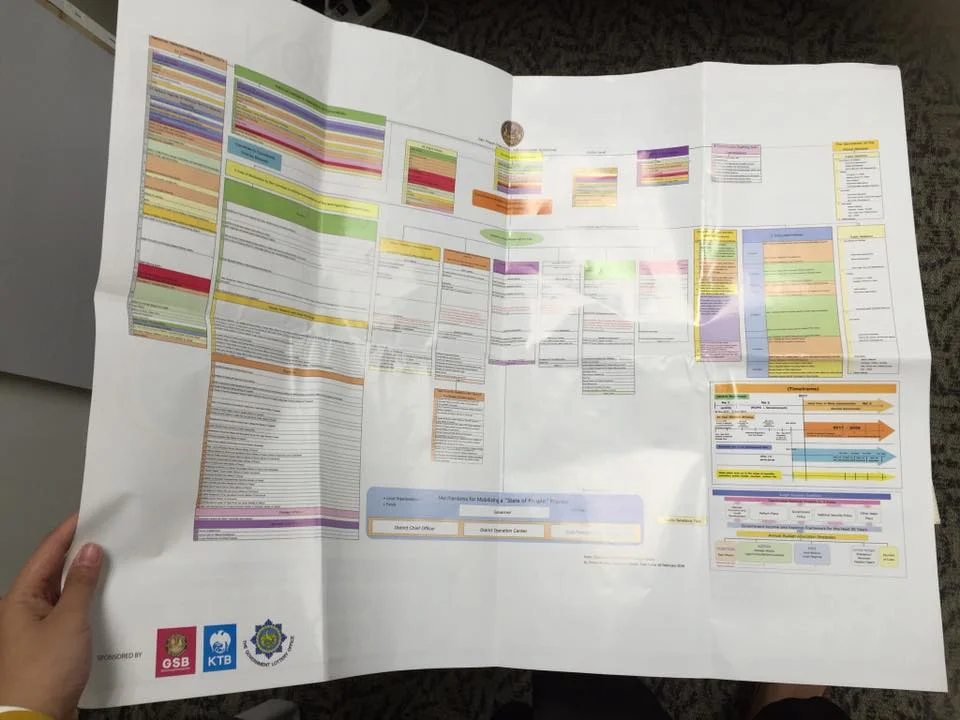


11025623_10154608911152366_1277160416811391931_n
One noteworthy item in this unattractive centerfold is the junta's purported timeline in the right bottom corner, which claims to hand back power to an elected government sometime in 2017, while also already setting off a "20-Year National Strategy Plan". The plan, which in fact is a bill, came out of the National Reform Steering Assembly (NRSA, a fully-appointed government body) and was passed by the fully-appointed legislative body last week. The bill sees the establishment of a 25-member group that seeks to dictate long-term policy goals to the cabinet, which could be yet another mechanism to restrict an elected government. It's not made better by the fact that members of the current junta, including Prime Minister Prayuth, will be on this panel for the first few years.
The backside is probably the most egregious part of this pamphlet, attempting to explain why its policy of "Pracharat" (commonly translated as "state of the people") is the polar opposite to the "evil" populism-schemes of the previous governments the military has ousted – even if the former is currently nothing but the junta's hottest buzzword as it has yet to be defined into actual policies, unless it's just a simple rebranding.
https://twitter.com/JeromeTaylor/status/702707785222344704
However, the coup de grâce is found in the bottom half. Not only does the graphic un-ironically define how a "pseudo-democracy" differs from a "genuine" one (considering the current state of Thai politics), but it also tries to cram several dozens of items from the centerfold into just three small boxes – and fails miserably ...

https://twitter.com/Journotopia/status/702681008504598528
All in all, it does beg the question: what is the military junta is trying to achieve here? It is not going for maximum exposure since it has published this pamphlet in three four newspapers, only one two of them in Thai, thus leaving international readers as the likely target audience. However, given the authoritarian rule of the government, it won't be easily swayed by some loftily phrased aspirations – let alone by that giant policy diagram.
The last time the military published a diagram, it was a largely unfounded mess. This time, it published a series of haphazardly-constructed infographics, making things more difficult to understand to the general public. The junta's long-term policy vision just mentions democracy as a side note and reinforces a paternalistic style of governance, seeing itself as the ultimate arbiter of the future direction Thailand is taking, while at the same time completely muddling its message.
But then on the other hand, transparency has never been the military's strong suit.
Correction: An earlier version stated that three newspapers have carried the Thai junta's advertorial. It is four - in addition to Bangkok Post, The Nation, Post Today, Thai-language daily Thai Post also ran this.
h/t to several Twitter followers and readers for providing photos and copies of the pamphlet.
Exiled Thai academic accuses military junta of threatening his family
Originally published at Asian Correspondent on February 25, 2016
The Thai military has allegedly threatened the family of self-exiled academic Pavin Chachavalpongpun, Associate Professor at the Center for South East Asian Studies at Kyoto University and currently a visiting scholar at the University of Cambridge.
The scholar wrote on his Facebook profile on Wednesday evening that army officers have appeared at his house and called one of his sisters, demanding them to tell Pavin to "stop all activities overseas" – especially "talking about the monarchy" – or else his "family will have to bear the consequences" and demanded his entire family to "report themselves at the army camp".
AFP's Southeast Asia correspondent Jerome Taylor tweeted Thursday that junta spokesperson Colonel Winthai Suvaree told the agency that he had no information on authorities' contact with Pavin's family.
Pavin is known for his outspokenness on Thai politics – including the monarchy – and even more so since the Thai military summoned him among hundreds of other academics, politicians and journalists in the aftermath of the 2014 coup, while he was based in Japan at that time. He openly refused to comply and, in his typical mischievous online manner, replied mockingly on Facebook if he could send his pet dog instead.
Shortly thereafter, the military junta revoked Pavin's passport, practically exiling him. But that didn't stop him from slamming them in numerous opinion pieces in the foreign press and also traveling abroad, giving lectures and participating in academic events discussing the current state of Thai politics. One of these events was this Wednesday on the future of the Thai monarchy at Oxford University, which was the likely cause for the Thai military's alleged harassment of Pavin's family. In the past, Pavin has accused Thai authorities, through their consulates and embassies, to have attempted to sabotage these public events either by discouraging Thai students from attending or pressuring the hosting universities to cancel.
Furthermore, Thai authorities have attempted to ask Japan to extradite Pavin on the premise that not only did he not comply with the military summons, but also that some of his articles were deemed "insulting to the monarchy" or lèse majesté, an offense punishable with up to 15 years in jail and rigorously (ab)used under the current military government. The junta has also asked other countries like New Zealand and France for extradition of lèse majesté suspects that have fled Thailand.
Thai junta PM embarks on day-long rant after criticism of constitution draft
Originally published at Asian Correspondent on February 3, 2016 The Thai military government's intolerance towards dissent is nothing new. But its reactions against criticisms of the newest constitution draft - over a single day, no less - is a renewed display of insecurity by the junta.
Either you're damned if you do or damned if you don't. That's the conundrum Thailand's military government has put itself ever since it seized powers in the 2014 coup, suspended electoral democracy and almost every other aspect of political discourse and freedom that comes with it.
While its rule is undoubtedly authoritarian, the junta has promised to "reform" the political system, introduce a new constitution and then to hold new democratic elections in late 2015 - before postponing it to early 2016, then delaying again to mid-2016 in order to accommodate for a public referendum on the constitution draft and then it got delayed yet another time to 2017 because that draft didn't make it through the junta's fully appointed ersatz-parliament and the whole drafting process had to begin all over again.
Last week, the Constitutional Drafting Committee (CDC) (whose members were all replaced after the first draft failed) presented their second attempt to the public (PDF) which will be directly put up to a public referendum this summer. However, the contents and their intentions are largely the same as the previous one, aiming to restrict the powers of elected governments and have more unelected forces to easier intervene (we will address the contents of the draft in a future story).
To make matters more dubious, CDC chairman Meechai Ruchupan already hinted before the publication that elections could be further delayed beyond mid-2017 to accommodate more time for organic laws to be drafted and implemented. However, Thai junta leader and prime minister Gen. Prayuth Chan-ocha later reaffirmed that democratic elections will actually take place in July next year, even if the constitution draft ist rejected in the public referendum - only then to change his mind on Monday again and widened out the timeframe to the whole of 2017.
That only further fueled suspicion and criticisms and seemingly this has all come to a head on Tuesday with a string of incidents and reactions that show how thin-skinned the junta is.
It started in the morning with the temporary detainment of Jatuporn Prompan, a prominent leader of the red shirts, a protest group that largely supports the toppled government of former prime minister Yingluck Shinawatra and her brother, the also deposed ex-PM Thaksin. The red shirts have announced last week that it would boycott the draft constitution, which is the likely reason for Jatuporn's brief detainment - or "attitude adjustment" as the junta's euphemistically calls it. He was released later in the afternoon.
At roughly the same time at Government House, prime minister Gen. Prayuth started lashing out at reporters, triggered by a question concerning the current constitutional drafting process and the delayed election date, saying things like "If you wanna vote, then go vote - you get the crappy ones [in the parliament], what are you gonna do then?" or "If the country goes down, don't come blame me!"
All this venting took place while he was inspecting exhibition stands, making it for those involved a possibly very awkward photo-op (see video below). As he was sniffing a wooden chicken and reading some labels he continued yelling: "I understand everything because I read! Are you reading anything? Have you read anything that the government is doing something good?!" When a reporter asked him what he was actually referring to, Gen. Prayuth fired back with: "If you're an idiot than look it up yourself!"
https://www.youtube.com/watch?v=37BwpY__EYQ
Meanwhile, Gen. Prawit Wongsuwan, the junta's number 2, deputy-prime minister and defense minister, commented on Jatuporn's brief detainment by saying that "constructive criticism" on the draft constitution is welcomed by the military government, but it must be "civilized", not using such words like "dictatorship", let the junta do its job, not "inciting unrest" - or else be "invited" for another round of attitude adjustment.
By the afternoon after the weekly cabinet meeting, PM Gen. Prayuth held another press conference and continued his tirade, claiming that nobody's helping him whenever he gets pelted by criticism: "Why is nobody talking about my rights? (...) I have democratic rights, too! You don't defend me, but you defend all these scoundrels?"
The reporters continued asking the still visibly agitated prime minister (see video below) with such questions like on the unclear sections of the draft (to which he replied "Why do you wanna know all this? You want this [draft] to fail, do you?!") or on the criticisms against the draft that it would create further political conflict instead of resolving it ("Who is inciting conflict, apart from politicians, apart from the press?! Who else?! Tell me!!").
https://www.youtube.com/watch?v=mWfnFPugyO8
He concluded his fiery press briefing by bemoaning the lack of trust he has by the public (despite a recent government poll attesting him a "98.9 per cent" approval rating, even though we all know better): "You don't trust me at all after these two years? Haven't you seen the work I've done? [slams podium] HUH?! You trust all the others, but not me!!"
Even for Gen. Prayuth, known for his often mercurial and sardonic outbursts in public, the constant criticism and skepticism towards the military junta's constitutional draft process must have hit a nerve. It displays a distinct lack of confidence and insecurity in the process to go on ranting for almost a whole day.
It also explains why a spokesman for the military junta has come out reiterating that the junta "never prohibits criticism or expression of opinion,” but asks for discussions of the draft to be held "respectfully". The thing about respect is that it is mutual - something that the Thai military government and its leader clearly does not show and Tuesday tirade was no exception.
Tongue-Thai’ed – A woman's (supposed) worth in a military man's world
Originally published at Asian Correspondent on February 1, 2016 This is part XXXII of “Tongue-Thai’ed!”, an ongoing series where we collect the most baffling, ridiculous, confusing, outrageous and appalling quotes from Thai politicians and other public figures. Check out all past entries here.
AS we're entering the second full year of the Thai military government and with things likely to stay the same for the foreseeable future, one thing is for certain: we're still have to endure another year of the junta's authoritarian rule. But it also means that we will have another guaranteed year of the generals putting their foot in their mouths, be it out of temper, not enough understanding of a certain matter, or just hypocrisy. For the even more ridiculous and outrageous ones we fortunately have our long-running "Tongue-Thai'ed!"-section, a standing record of astonishing verbosities of Thai public figures.
And no other Thai public figure has been delivering it like Thai junta leader and Prime Minister Prayuth Chan-ocha. For several years already, back when he was 'just' army chief, Il Generalissimo has regularly contributed to this section here and it has only increased when he assumed the highest ranking political office in this country. Be it his constant aggressively sardonic remarks against reporters, his lengthy rants during his weekly TV addresses, or other seemingly off-script moments, his compulsive loquaciousness always causes a raised eyebrow or two. And the first Tongue-Thai'ed! of 2016 is par for the course.
A man of his (thousand) word(s)
Prayuth spoke on Friday at an event originally promoting vocational education, but the junta leader decided to temporarily talk about something entirely different.
"Everybody's saying that we should create equality, women and men should have the same rights, should be able to do the same good and bad things - if that's the case, if that's how you think, Thai society will deteriorate!"
Erm, yes... Gen. Prayuth and his government ministers have stated several times in past what they think is going to lead to Thailand's downfall - such things like "extreme human rights", people voting for the wrong party, limiting military power and just generally "too much democracy". For the generals, these things have brought Thailand to the brink of collapse and made the 2014 coup necessary.
Prayuth continues:
"Women are the gender of motherhood, the gender of giving birth. When you return home... who is it? Who has a wife? Isn't the wife looking after the home? At home she's the big boss, isn't she? Outside I'm the boss - at work, everywhere I have lots of authority. When I return home, I have to be quiet because she's looking after the home, the kids, everything in the house. I haven't done anything at home since we married, she's doing everything."
It seems that Gen. Prayuth is mixing up women's rights with women's (supposed) roles in the family and at home - and still gets it wrong for the most part or at least it sounds awfully antiquated. But okay, he's from a different generation with very distinct gender roles and at least also admits one area in his life he has absolutely no control over.
He then concludes:
"That's why I have my head free to think about everything [else], not worrying about anything, not picking up the kids, not doing anything at all, because I work far away from home. That's the small difference! But all the bad things I have done to her, have benefitted others. That's what I think."
Wait, "all the bad things I have done to her" ("แต่สิ่งที่ผมทำไม่ดีกับเขา")? Did he just admit something he shouldn't have said? And who's benefitting from that? Let's assume for a moment that Gen. Prayuth, in his usual off-script manner, meant with that "the things I haven't done for her" - which still shows that he's absolutely unwilling to do anything in the family household!
All in all the whole quote is astonishing and reveals Gen. Prayuth's thoughts about women: stay at home, do what you're told, look after the kids and don't make any demands!
What doesn't seem to be clear to him is the fact that he is prime minister over a country with a female population of 50.7 per cent and they comprise roughly 45 per cent of the country's workforce, which makes it among the highest rates in Asia. Thailand has also an above-average number of women in senior management positions. However, despite countless policies and campaigns by previous administrations, a lot more women are still facing at least some discrimination at work.
Other women's issues in Thailand are still in need of improvement as well, such as abortion still being illegal (with very extreme exceptions), sexual assaults still ineffectively dealt with, female Buddhist monks still not recognized, sexual hypocrisy still prevails with a stark bias against women. In fact, the country is currently ranked 93rd out of 188 in the most recent Gender Inequality Index by the United Nations Development Programme (PDF, page 225).
Women's representation in politics has been rather low in recent years and even lower since the military junta took over, with now a meager 5 percent of women in the junta's fully-appointed legislative assembly (from previously 15 per cent). Thailand's only female prime minister so far, Yingluck Shinawatra, was never supported by Thai women's groups, solely for political reasons, until the 2014 coup.
Which brings us back to Gen. Prayuth - the same man who suggested after the murder of two British backpackers in 2014 that tourists wearing bikinis wouldn't be safe "unless they're not beautiful" (for which he later apologized). His views about family values and clearly defined gender roles reflect the old Thai saying that "the husband is the fore leg of the elephant, the wife is the hind leg" ("สามีเป็นช้างเท้าหน้า ภรรยาเป็นช้างเท้าหลัง") - and for him, that should stay the same. But what if the front leg has been limping for a while?
P.S.: Ironically, the Royal Thai Air Force announced last week that they're looking to hire female pilots for the first time amidst a shortage of male pilots.
Thailand in 2015: Some personal thoughts
Originally published at Siam Voices on December 24, 2015 A definitively incomplete look back at a year in 2015 where few things made headlines for the right reasons.
FOR the second time since its most recent assumption of powers, the Thai military junta has presented its annual government performance to the general public. This was the opportunity for the cabinet of junta leader and prime minister General Prayuth Chan-ocha to show what it actually has achieved in its first full year ruling over Thailand. But for some reason, it has cut the schedule down from three days last year to just one day today.
This is also the fifth time that I’m writing a year-in-review ever since I started covering Thai politics. This is the opportunity for me to reflect and comment on the developments in the political sphere in order to help the general public understand what the hell is actually going on in the circles of power. But for some very specific reason, this year’s exercise is an exceptionally frustrating one.
Last year, I wrote about the metaphorical arsonists that have caused the death of Thai democracy as we knew it and those complicit in it. The latter have now been largely sidelined since then, as well as their political enemies.
If 2014 marked the watershed moment in Thai history, 2015 was largely a continuation of the season of infamy.
The Thai military government - with all its doublespeak about their so-called "roadmap” back to democracy, its nonchalance about the blurred lines between military and government, its incredibly tone-deaf verbosities and compulsive loquaciousness, its "attitude adjusting" detainments and ultimately its blunt threats against those daring to oppose or those just simply doing their jobs - has put this country in a petulant state of revertigo, a dizzying regression to old behaviors triggered by something in the past, or at least what should be in the past. Or to put it in the words of a Thai education official, a "360 degree turn".
The junta's reimagineering of the political landscape, in which the powers of elected officials will be severely restricted or otherwise affected by outside intervention, was both dead on arrival and on schedule at the same time: on one hand, the junta was mulling over a referendum on the next constitutional draft, but also delaying the possible election date, which was initially set for late 2015, but kept getting pushed back further and further. The next possible date for new polls has now been pushed even further at mid-2017, since the draft was rejected by the junta-appointed legislative and the whole process started anew. And that on the other hand just simply extended the junta’s rule, as it claims that it will definitely hand back power in 2017 - unless they decide otherwise.
It seems that almost nothing can dampen the junta’s rule: not the still-sagging economy, not the ongoing cases of slavery in the fishing industry, its poor handling of refugees (if they were not deporting them back), or the air traffic security downgrade. Not even the bomb attack on August 22 at Bangkok's busy Erawan shrine that killed 20 and injured over 100 people has shaken the generals too much, as it has self-congratulatorily declared the case closed after a shambolically contradicting investigation. Just don’t call it an act of terrorism.
Other "achievements” by this government would be too long to list all of them here (as well as PM Gen. Prayuth’s almost daily sardonic hissy fits), in a year where very few things indicated progress and even fewer cases where common sense has prevailed, such as the tiny advancements in LGBTI rights and the dismissal in the libel case against the Phuketwan journalists.
The ongoing rule of the military junta also unsurprisingly signals the ongoing regression of human rights and freedom of speech, as dissidents are detained in what officials euphemistically call "attitude adjustment” and assemblies are outlawed (unless you are an ultra-nationalist protesting against the US embassy). Political parties across the spectrum have been rendered irrelevant, either unable and unwilling to engage in the current political climate, leaving the field to a very few but brave student activists.
Lèse majesté has reached its lowest point yet in 2015, as both criminal and military courts have handed out record sentences and arbitrarily extended the definition of the draconian law, from vague allusions in university theater productions to sharing Facebook posts mocking the King’s dog.
The military government has also extended its front lines online as well. The new proposed Cyber Laws aim to create the foundations for "digital economy”, but also enable widespread online surveillance, prosecution against intermediaries (just on Wednesday the alternative news website Prachatai lost its appeal) and more legal uncertainty, benefiting the state more than Thai online users.
Compared to that the junta’s plans to bottleneck internet traffic through a "single gateway” to filter unwanted content was just the icing on the cake - and something that sparked a rare display of civil disobedience, as online activists crashed government websites, sending officials scrambling for an appropriate response. While the government states it isn’t pursuing those plans any more, one shouldn’t be surprised if the single gateway and other means to control the narrative online will pop up next year.
But that is a losing battle and no other case has proven it more than the Rajabhakti Park corruption scandal. What was initially planned as yet another big display of the military’s loyalty to the monarchy worth around 1 billion Baht ($28 million) has descended into a massive headache for the junta, as military officers are accused of receiving kickbacks and suspects in similar cases have died in custody. The junta has so far responded in the only way it can: by detaining critics and crying conspiracy.
What this and the year as a whole shows is that the assumption of control by the Thai military junta remains a textbook definition of an assumption - one without proof or legitimacy that will be constantly challenged. The junta is obviously playing the long game sitting comfortably at the helm for the foreseeable future in one form or another, it is mounting a battle of attrition for its opponents.
For me personally, it is a battle against cynicism. The actions by those in power are self-evident and predictable, yet stupendously brazen and unashamedly blatant in their execution - in that regard that is pretty much the status quo for Thai politics in general regardless of what era we are talking about. But wouldn’t that be the lazy way to explain all this and then leave the foreseeable future to be damned like this? Wouldn’t it be cynical?
I honestly don’t know any more, because my articles over the past five years have chronicled the systematic failure of the Thai political discourse by nearly all involved, hence it is no surprise how we got here where we are now. And it still seems that we haven't reached the worst yet. But how many more years are we gonna be trapped in this repeating state of revertigo and how will this cycle be broken? The answers to the question may already have been given multiple times along the way, but amidst this constant regression in Thailand, how many more times do they have to be repeated?
Analysis: US to play the long game with Thai military junta, but not forever
Originally published at Siam Voices on December 18, 2015 ”YOU always meet twice in your life,” is a saying Germans used to tell each other, which can either be a simple figure of speech when two people say goodbye - or it can also be a reminder that no matter on what terms you part ways, you might have to settle your issues in the future.
When news broke that for the fifth Thailand-United States Strategic Dialogue a certain Daniel Russel would return to Bangkok, certain people within the Thai military government might have been seething at the announcement. The last time the U.S. Assistant Secretary of State for East Asian and Pacific Affairs was in town, he left a particularly sour taste among the generals.
In January earlier this year - not quite a year after Thailand’s military seized power in the coup of May 2014 and half a year since junta leader Gen. Prayuth Cha-cha was made prime minister - Mr. Russel visited Southeast Asia, meeting with then-Foreign Minister Gen. Thanasak Patimaprakorn and those political stakeholders that have been largely sidelined since the coup, namely toppled former Prime Minister Yingluck Shinawatra and her opposition Democrat Party leader Abhisit Vejjajiva.
However, Russel also gave a speech at Chulalongkorn University, in which he said in no uncertain terms that the military junta’s crackdown on dissenting opponents under (at that time still active) martial law and the apparent unwillingness to foster an inclusive political discourse is putting a dent in the long-running relationship between the two countries. And indeed the United States sent early signals of initial disapproval of the coup, suspending $3.5m in military aid (which is still a drop in the ocean compared to the current military budget of $6.07bn) and scaling down the annual joint-military exercise ”Cobra Gold”.
These critical remarks led the Thai military government to throw a week-long overzealous, yet insecure temper tantrum, with Prime Minister Gen. Prayuth verbally retaliating by declaring himself to be a ”soldier with a democratic heart,” while being well aware that his ”government came from a [non-democratic] seizure of power,” but still telling that ”the United States doesn’t understand” what’s going on, only then to let his frustrations out by scolding Thai reporters again. At the same time, US Chargé d’affaires W. Patrick Murphy was summoned ”invited” by the Thai Foreign Ministry to receive a high-level earful and insisting to relabel the coup was a ”revolution to install stability”.
Eleven months later, Glyn T. Davies, an experienced diplomat, took over as ambassador, ending a 10-month vacancy that was less a snub against the Thai junta and more due to domestic political squabbles back in the States. However, his decisive criticism of the notorious lèse majesté law during his introduction at the Foreign Correspondent’s Club of Thailand (FCCT) has drawn the wrath of ultra-nationalists, protesting at the US Embassy (and apparently the only ones allowed to do so) and even going so far as to file a lèse majesté complaint against Ambassador Davies - and even more amazingly, the police actually launched an inquiry.
With that in mind, the strategic talks earlier this week already came with some baggage - which might explain why the joint statement (which can be read in full here) after the six hours-talk has been rather nuanced in expressing what it agrees on, such as public health, disaster relief and combating human trafficking. Nevertheless, Mr. Russel himself made sure during a personal meeting with Prayuth that while the United States wishes to ”restore full engagement with Thailand,” it would only happen when it ”restores a civilian-led and democratic government,” and he also raised concerns on the ever-deteriorating human rights situation. Gen. Prayuth responded by explaining the junta’s ”reforms” to the political system before there’ll be any elections (if at all).
The current approach by the United States could hint at a few things: While the US maintains consistent concern over the dire human rights situation in Thailand, it also understands that things are not going to change politically anytime soon. Thus, the confirmation of Ambassador Davies was already an early sign that it needs an experienced diplomat to engage with a mostly uncompromising Thai military government that is going to stay longer than anybody initially anticipated - and his dealings with the nuclear programs of Iran and North Korea before certainly could come in handy. Nevertheless, most Western countries have still stopped short from branding Thailand a pariah state, most likely to prevent from completely driving the country into the arms of both China and Russia.
But the U.S.'s patience isn't infinite, as lawmakers back in Washington have already expressed their frustration at the lack of progress (or rather the reversal of any progress). In a rapidly changing region (with one neighbor in particular) that comes with new geo-political challenges and economic potential, it requires multi-lateral cooperation from consistently reliable partners. One such 'incentive' could be brining Thailand into the Trans-Pacific Partnership (TPP), a regional U.S.-led trade agreement that already has Japan, Malaysia, Vietnam, Singapore, Brunei, Australia, New Zealand, Canada, Mexico, Chile and Peru on board - that is IF Thailand actually meets the requirements and the military government can convince their otherwise FTA-critical political supporters, who have been largely mum on this matter so far.
The visiting U.S. diplomat Daniel Russel went on record after the bilateral strategic talks, stating he got a "full and respectful hearing" by the Thai military government, a slight contrast in tone compared to his last visit in Bangkok. That should not be mistaken as a softened stance though. The U.S. is prepared to play the long game with the Thai junta, which is persistently solidifying its authoritarian rule. And that probably will lead to more chances to meet again in future - the question will be on what terms?
Rajabhakti Park: The corruption case the Thai junta doesn’t want you to talk about
Originally published at Siam Voices on December 17, 2015
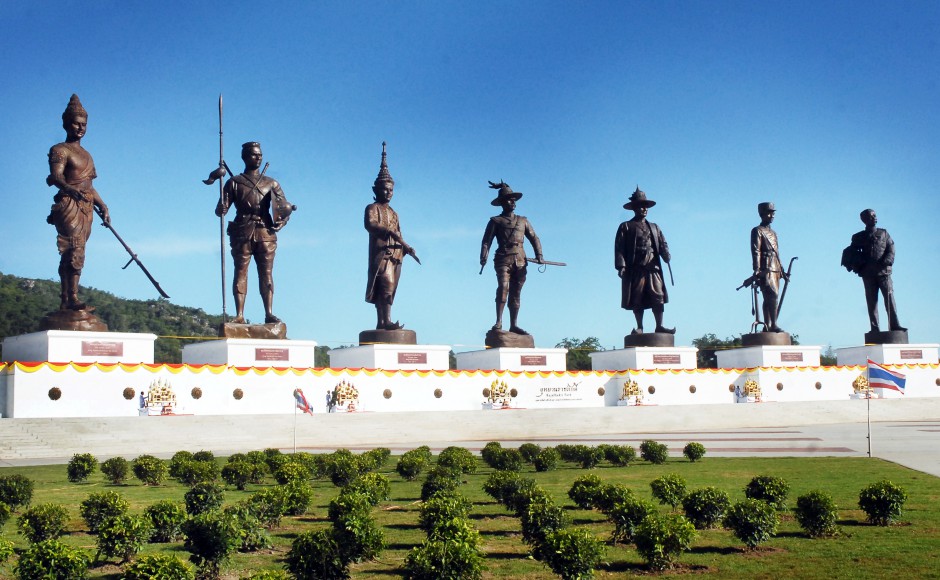
The ongoing controversy over alleged corruption at a military-sponsored park and other events to honor Thailand’s monarchy is becoming a big headache for the military government, as it struggles to uphold its own pledge of a ”clean” rule and instead cracks down on criticism.
IT was supposed to be a monument to honor the past: seven giant bronze statutes of seven past Thai kings - from the Sukhothai period (1238 - 1583) to the current ruling Chakri dynasty (since 1782) - were erected in a newly built park near the royal resort town of Hua Hin.
Rajabhakti Park is a project sponsored by the Thai military in another very public display of its loyalty to Thailand’s monarchy, of which it regards itself to be its ultimate protector amid growing concerns over the health of long-reigning King Bhumibol Adulyadej, who turned 88 years old earlier this month.
But one year after the project's initial announcement and with the construction of the park pretty much completed, the Thai military junta is being besieged by allegations of corruption and has so far not been able to convincingly refute them.
The first rumors surfaced in early November as irregularities in the financing of the tall bronze statues were called into question. Specifically the high costs of reportedly 43 to 45.5 million Baht ($1.19 to $1.26 million) each, with payouts to middlemen, including an army colonel and several amulet traders, of roughly 10 percent "commission”called into question.
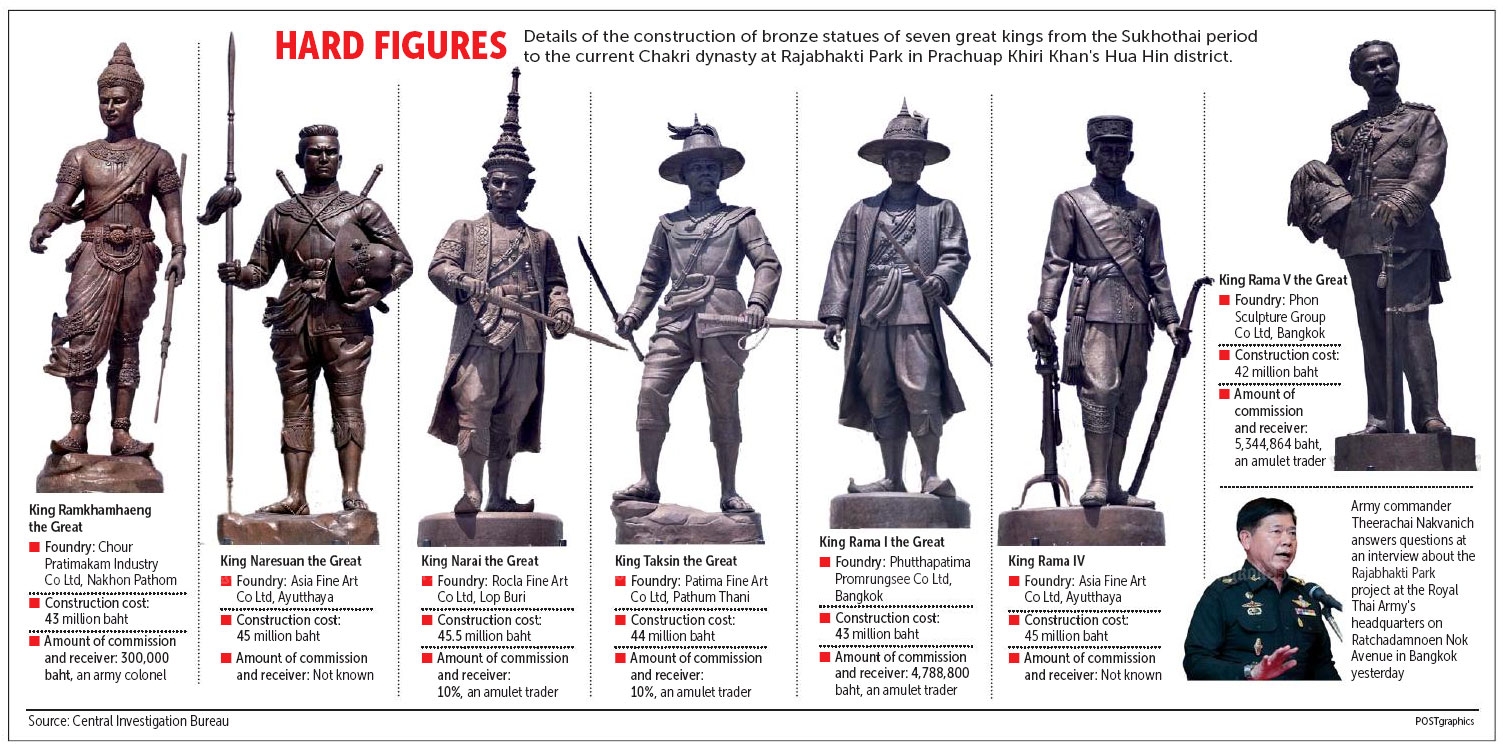
Right from the beginning of the case, the military government has denied any irregularities or involvement of any army officers, while deputy prime minister, defense minister and former army chief General Prawit Wongsuwan repeatedly insisted that this is ”not a government matter, it’s the army’s” - suddenly distinguishing the junta and the military as two separate, independent entities.
The royal park project was initiated and supervised by General Udomdej Sitabutr, army chief from October 2014 to September 2015 - exactly the same time it took for the completion of the park. An internal investigation in late November, led by his successor and current army chief General Teerachai Nakwanich (reportedly a protege of Gen. Prawit), declared ”there is no corruption” in the case and ”everything was transparent”, while not giving any details about the inquiry itself and at the same time telling off the media from further digging into the matter.
Just days after the military declared the case closed, Gen. Prawit announced the launch of a new investigation led by defense permanent-secretary General Preecha Chan-ocha - who also happens to be the brother of junta leader, prime minister and also former army chief General Prayuth Chan-ocha. The probe is expected to be completed by the end of the year.
Another investigation by the Office of the Auditor General, the National Anti-Corruption Commission (NACC) and the Office of Public Sector Anti-Corruption Commission found out that 63 million Baht ($1.7 million) of state budget was used in the project, contradicting an earlier statement by Gen. Prawit that the money came entirely from donations. Coincidentally, the chairman of the NACC was removed two weeks later by order of the military junta and replaced by Watcharapol Prasarnrajkit, a police general who happened to be secretary-general to Gen. Prawit shortly after the coup.
The Rajabhakti Park case is just one part of a wider purge in recent months, in which several high-ranking officials face lèse majesté charges for allegedly enriching themselves with either false claims to the royal family or abusing their connections to it. Some cases are tied to mass bike rallies to honor Queen Sirikit and King Bhumibol in August and December, respectively.
Two of the suspects, a police major and a prominent soothsayer, died in military custody on October 23 and November 6, respectively. Their bodies were hastily cremated within a day (not in accordance with Buddhist week-long funeral rituals), but authorities have ruled out foul play in both cases. The whereabouts of several other targeted officers is unknown. Some are rumored to have fled the country.
Whatever the inquiries will unearth (or not), the Thai military government is already practicing the worst kind of damage control by cracking down on its critics. Pro-democracy student activists and two red shirt leaders (a group supporting the toppled government of former Prime Minister Yingluck Shinawatra), respectively, have attempted to visit the park, only to be intercepted and detained by authorities on the way there.
Thai officials have also arrested two men for sharing (not creating) infographics on the Rajabhakti Park corruption case on Facebook: a 25-year-old man taken into custody at a hospital while he was awaiting surgery, and a 27-year old factory worker, who has reportedly confessed. Both men, currently in military detention, are being charged for violating the Computer Crimes Act and for sedition, the latter carrying a sentence of 7 years.
The 27-year-old suspect is being additionally charged with lèse majesté, which alone can carry a maximum prison sentence of 15 years per offense. It was revealed later that one of the offenses was sharing (again, not creating) contents on Facebook that mocked the king's dog. That in itself marks an even wider interpretation of Article 112 of the Criminal Code - which only mentions "the king, queen, heir-apparent, or regent" - after previous rulings have expanded the law to past kings and even "attempted" insults. Punishments under the notorious lèse majesté law have been particularly heavy-handed since the military coup: In August, two suspects have been given record sentences of 30 and 28 years in jail, respectively.
Thai authorities have also announced its intentions to charge ”hundreds” of Facebook users with lèse majesté as well as for 'liking' offending content. Meanwhile, Gen. Prawit told reporters last week not to ask too much about the scandal, as "there's no point" to further press coverage of issue. He added, “Please stop mentioning this already. It damages confidence a lot. You’re Thais, why do this? The government is working for the country. Therefore, the media must help us out.”
The ongoing controversy over Rajabhakti Park could slowly become the biggest problem for the military junta so far, which has been only able to respond to criticism by stifling it. Not only does it face the tainting of its biggest showcase of loyalty to the monarchy - a nigh-endless source of pride for the army - but this is also a slap in the face to junta leader and Prime Minister Gen. Prayuth Chan-ocha, who has pledged to crack down on corruption. An opaque investigation and more furious backlashes against critics could further undermine a government that is desperately seeking legitimacy that is looking increasingly elusive.
EU extends invitation to ex-Thai PM Yingluck - but will the junta let her travel?
Originally published at Siam Voices on November 24, 2015
A LETTER appearing to be an invitation by European Union parliamentarians to former Thai Prime Minister Yingluck Shinawatra to talk at the EU is being circulated in Thailand, sparking speculation about her future whereabouts amidst criminal charges at home and implications for the relations between the EU and the Thai military.
Signed by Members of the European Parliament (MEPs) Elmar Brok and Werner Langen, the letter (see below) recalls Yingluck’s visit to the EU in March 2013, before addressing the current political situation in Thailand under the military junta "with concern". The letter concludes with an invitation to the former prime minister for an ”exchange of views … either in Brussels or in Strasbourg.”
Yingluck and her Pheu Thai Party-led government were toppled in a military coup on May 22, 2014 following over half a year of sustained anti-government protests. She and hundreds of Thais, including her cabinet ministers and party colleagues, were detained for several days by the military at various places in the country, before being released under the condition that they not rally against the Thai junta.
Since then, she has been impeached by the National Legislative Assembly (NLA), an ersatz-parliament fully appointed by the military junta, and is now facing criminal charges at the Supreme Court for alleged negligence over her government’s rice subsidy program.
The policy - in which the government bought the rice from farmers at roughly 50 per cent more than the market price - was hugely popular among her party’s rural electorate and is credited to have helped her secure a landslide election victory in 2011. But the rice scheme program was slammed by critics for alleged cases of corruption, a huge financial loss of reportedly 500 billion baht ($14 billion) and millions of tonnes of rice rotting away in stockpiles while still waiting for a buyer. The latest reports suggests that 2 million tonnes of rotten rice have been approved for sale, which then can be used for industrial purposes such as the production of ethanol.
Amidst that, the letter from Europe comes at a peculiar time. Thai-language daily Khaosod reported on Monday that it received word from the Pheu Thai Party about the letter, a copy of which was later circulated by its sister publication Matichon. Other media outlets reported, based on sources close to Yingluck, that she hasn't decided yet whether to accept the invitation.
Since the coup last year, several Western countries have downgraded their relations with the Thai military government, including the European Union. Not only has it banned any state visits on and above ministerial levels, it also suspended talks over a potential free trade agreement in the immediate aftermath of the coup (much to the annoyance of European business lobbyists in Bangkok). The likelihood of a resumption of talks is "probably zero”, according to Miguel Ceballos Baron, a top aide to EU Trade Commissioner Cecilia Malmström. He added that ”it’ll be never ratified” as long as the junta stays at the helm.
In light of the deteriorating human rights situation under the Thai military junta and the deep revamp of the political system under the guidance of the generals, several European parliamentarians across the political spectrum criticized the current regime in October. The European Parliament as a whole passed a non-binding resolution condemning the ”illegal coup of May 2014” and demand to ”overturn convictions and sentences, to withdraw charges and to release individuals and media operators who have been sentenced or charged for peacefully exercising their rights to freedom of expression or assembly.” (Full text here)
The letter to Yingluck is dated October 7, a day before the vote in the EU parliament. The signatures are apparently those of MEPs Elmar Brok and Werner Langen, both from Germany and members of the European People’s Party (EPP), consisting of national Christian democratic and conservative parties. Mr. Brok is the longest-serving member of the EU parliament and has served as the chairman of the EU foreign affairs committee since 2012, a position he held previously between 1999 to 2008. Mr. Langen, an MEP veteran of over 20 years, is the chairman of the EU parliamentary delegation to ASEAN. Both men are also co-signatories of the aforementioned resolution condemning the Thai junta (full voters' list).
Whether Yingluck will travel to Europe is entirely up to the junta. While it allowed her to travel to Paris in July 2014 for the birthday of her exiled brother and former PM Thaksin, the generals banned her from traveling abroad without prior consent immediately after last year's coup, and again earlier this year, in order to prevent her from fleeing into exile (like her brother), shortly before her indictment over the aforementioned criminal charges for the rice scheme policy.
Asian Correspondent has reached out to MEPs Elmar Brok and Werner Langen for comments.
+++UPDATE 20.30h - Nov 24, 2015 +++
One of the co-signatories of the invitation to former Thai prime minister Yingluck Shinawatra has confirmed the letter's authenticity. "Yes, the letter is by me and Mr. Brok," says Werner Langen, MEP, in reply to an email by Asian Correspondent. He hopes that "the military government will allow" Yingluck to travel to Brussels or Strasbourg. Furthermore, Mr. Langen says that the European Union wants to assist Thailand with "a return to democratic structures contribute a reconciliation between the rivaling factions."
Thailand's indefinite roadmap: Prayuth threatens to 'stay on' in power
Originally published at Siam Voices on October 30, 2015 Thailand’s military government is becoming increasingly blatant about its intentions to stay in power
THAILAND'S Prime Minister Prayuth Chan-ocha has never been shy about letting everybody know his opinions. The junta leader also expects everybody to listen. Nobody knows that better than the local journalists who have endured the daily press briefings by the PM that have more often than not turned into prolonged tirades (as we have reported previously). The rest of the country might have caught some nuggets of his wisdom during his weekly TV addresses while waiting for their nightly fix of local television's ubiquitous and hugely popular soap operas.
It’s one and a half years into the rule of Thailand’s military after it took power in the coup of May 22, 2014. Its reign has been authoritarian, dominating nearly the entire political discourse, censoring the flow of information and intolerant of criticism and dissent - even if it's something as innocuous as an old man giving flowers to anti-junta protesters.
The junta has its hands in almost every institution that is currently re-writing the constitution, thus re-defining the rules for any future elected government - that is IF there is going to be an election any time soon. With a new timeframe for democratic elections in mid 2017 - instead of initially late 2015 - the military junta has postponed the date at least three times already. First the constitutional drafting process was blamed to be taking too long, then the generals granted a public referendum on the next constitution in exchange for another delay, and eventually the rejection of said draft constitution by a fully-appointed government body pushed it further back even further, since the whole process of writing a new constitution has to start over again.
But even when the rules for the currently sidelined politicans are set and the veneer of democratic normalcy is being prepared to be raised, there is no guarantee that that’s actually going to happen.
While Gen. Prayuth himself has decided to reduce his daily press briefings, he didn’t keep it short during a meeting of the self-titled "five rivers”, which includes the military junta, the cabinet, the National Legislative Assembly (NLA), the Constitutional Drafting Committee (CDC) and the newly established National Reform Steering Assembly (NRSA), this week.
In his speech Wednesday morning, a hot-headed Prayuth went on an extensive tirade clocking in at two hours and 15 minutes, attacking his opponents and ultimately culminating in this threat:
"Politicians do not have to be suspicious of me. [The media] writes every day that I intend to cling on to power. I must make it clear. If there is no peace and order, I must stay on.”
In other words, if there are any political groups or individuals are attempting to stage anything large-scale that the military government sees as a threat, it has a very convenient excuse to shut the country down.
Even though his Deputy Prime Minister Gen. Prawit Wongsuwan tried to downplay Gen. Prayuth’s threat, saying that the prime minister ”didn’t mean it literally” and people ”shouldn’t read too much into it”, it becomes increasingly obvious that this wasn't just yet another slip of the tongue by Gen. Prayuth and what the military junta is doing to ensure its grip on power, no matter how the political landscape looks in the foreseeable future.
As a return to democracy becomes more and more elusive, Thailand’s military rulers are turning the twindow for the next election into a time horizon: always visible, but never reachable.
Despite denials, Thailand's online surveillance plans are alive and well
Originally published at Siam Voices on October 22, 2015 "We will not talk about this any more. If we say we won't do it, we won't do it," said Thai Deputy Prime Minister Somkid Jatusripitak at an economic forum in Bangkok last week. His decisive words were in response to the ongoing controversy over the Thai military government’s plans to introduce an online single gateway.
Last month, Thai internet users discovered a cabinet resolution surveying the implementation of a single online gateway ”to be used as a device to control inappropriate websites and flow of news and information from overseas through the internet system.” Subsequent resolutions ordered the Ministry of Information and Communication Technology (MICT) and related agencies to speed up their preliminary work.
If realized, Thailand’s internet traffic would be bottlenecked through a single gateway, making it possible for officials to filter and block undesirable content. This is in line with the military junta’s ongoing efforts to monitor and censor dissenting voices, both in real life and online, ever since it launched a military coup in May 2014.
Amidst widespread criticism and a coordinated mass-click-and-refresh bombardment that briefly knocked several government websites offline, Thai officials were scrambling to calm public opinion, only then to contradict themselves justifying why the junta wants to have a single gateway in the first place. The explanations varied from economic reasons, cybersecurity concerns and ultimately ending at Thai junta leader and Prime Minister General Prayuth Chan-ocha being initially ”worried” about the ”youth addiction to online games and access to inappropriate media”.
A week later, the government was hoping that the debate had died down. However, despite repeated statements insisting that it won’t pursue the single gateway plan anymore, not everyone is convinced by their declaration. And it seems there is more trouble coming the junta’s way:
Online activists have announced they will launch attacks against the government beginning Thursday after the prime minister said the project to route all internet traffic through a single point of control is still alive.
The coalition of anonymous internet users known as Citizens Against Single Gateway last night warned private sector operations with IT systems linked to government servers to transfer them to safe places before the assault on government systems begins at 10am on Thursday.
Those behind a crippling attack earlier this month, the Thailand F5 Cyber Army, issued the announcement yesterday after Prime Minister and junta chairman Prayuth Chan-ocha said agencies are still studying the project (…).
”First Chapter of ‘Cyber War’ to Begin Thursday”, Khaosod English, October 21, 2015
The little detail that the government is "still studying" the single gateway plan is enough reason for opponents to distrust the Thai military government. But there are several more signs that justifies the continuous skepticism by many online users.
CAT TELECOM has announced that it will proceed with the plan to build a national Internet gateway, which it claims would help make Thailand a digital hub in Asean.
The aim of the project is not to control the flow of information into the country over the Internet as some fear, said CAT acting chief executive officer Colonel Sanpachai Huvanandana. He said a working committee for the project would be set up. Whether that committee is under the Information and Communications Technology Ministry or under the Digital Economy Committee is up to the ICT minister.
The national Internet gateway is one of two priorities for making Thailand a digital hub for the region by expanding capacity and reducing costs. The other is to have large content providers such as Facebook, Google and YouTube establish servers in Thailand.
”Net gateway for digital hub”, The Nation, October 21, 2015
The other part of the plan to have internet tech giants like Google and Facebook setting up shop in Thailand (the latter already did) seems ambitious to say the least, given a potentially significant infrastructural disadvantage and previous persistent, but unsuccessful attempts by the military government seeking cooperation of these companies to censor posts deemed insulting to the monarchy and also identify their authors.
At the same time it is being reported that General Thaweep Netrniyom, the secretary-general of the Office of the National Security Council (NSC), could be appointed the head of the aforementioned CAT Telecom. It would be the first time that somebody from the NSC would take up that position at the state-owned telecommunication company and unsurprisingly his focus is expected be on cyber security - just as CAT’s current CEO (a Colonel nonetheless) announced they are still not giving up on the single online gateway.
However, as mentioned before, that is not the only measure by the military junta to control the flow of online information in Thailand. It already has blocked more than 200 websites deemed a threat to national security (source), ordered internet providers to censor on sight, reportedly also procured software to intercept encrypted SSL-connections and additional hacking and surveillance software, it is also in process of passing its so-called cyber laws, a set of bills aimed officially at “preparing Thailand for the digital economy”. But it also includes passages that enables widespread online surveillance, prosecution against intermediaries (e.g. website owners) and more legal uncertainty, benefitting the state more than Thai online users.
Most recently, Defense Minister General Prawit Wongsuwan announced on Tuesday the creation of a new ”Army Cyber Center” specifically to ”protect” the Thai monarchy and to ”keep track of information on media and social media and to sort them out systematically,” essentially underlining their priorities. In August this year, two people were sentenced to a record 28 and 30 years in prison respectively for allegedly posting Facebook messages deemed insulting to the monarchy.
ConstitutionNet: Thailand’s post-coup constitution: Draft punked or ‘Once more with feeling’?
Originally published at ConstitutionNet on October 15, 2015 Thailand has to wait for a new constitution as the drafting process is being sent back to the drawing board with an entirely new Committee taking office last week.
Writing constitutions can be a very costly venture. How costly? In the past 10 months, Thailand’s Constitution Drafting Committee (CDC) was busy creating the country’s 20th constitution. The Committee members convened 158 times and accumulated a bill of 85 million Baht ($2.35 million), according to Thai media estimates– the catering alone cost 23.7 million Baht ($655,000). Was it worth it? Probably not. The constitutional draft did not survive the vote in the National Reform Council (NRC) on September 6, as the fully-appointed chamberrejected it with 134 votes to 105 and 7 abstentions. However, that didn’t really hurt Thailand’s military junta. Ruling since the Kingdom’s 12th successful coup in May 2014, the National Council for Peace and Order (NCPO), as the junta officially calls itself, have had a tight grip on the political process. With heightened media monitoring, censorship and arbitrary detainment of dissidents - euphemistically called ”attitude adjustment” - the junta also tries to control the official narrative.
Much Ado About Nothing?
Throughout the constitution drafting exercise, the stakes were incredibly low for the military government. As the Chairman of the NRC’s Legal and Justice Reform Committee has recently summed up: “The CDC is like a cook preparing food for the NRC. The NRC tasted the food and it was found to be not delicious.” On the one hand, a passed draft would have constitutionally enshrined the junta’s ‘reforms’ to the political system, which would have ended up severely restricting the powers of elected officials, be it through a new voting system, a fully appointed senate or several non-elected bodies that could usurp a co-existing, democratically elected government. On the other hand, a failed process buys another six months for the junta to cement its position and develop a draft constitution more to its liking – a win-win for prime minister and junta leader General Prayuth Chan-ocha.
From among several reasons, two stand out why the draft was struck down - sending back the constitution drafting process to its very beginning. First is the controversial late addition of the Committee for Reform Strategy and National Reconciliation to the draft constitution. Dubbed by the media as the ‘Crisis Committee’, it would have established a military-dominated, extra-parliamentary executive panel shadowing the cabinet of ministers that would have intervened during a yet-to-be defined “crisis situation”. The other reason for the rejection is, as with nearly all government bodies since the coup, the NRC had 29 members from either the military or the police force. CDC Chairman Borwornsak Uwanno hinted that all these members voted against the draft because of orders from their superiors – regardless that the whole process was initiated and dominated by the military junta in the first place. Whatever the reasons for orders were, it has definitely played into the hands of the generals. The failed draft vote has now conveniently extended the junta’s rule for at least another half year, as democratic elections are postponed yet again to mid-2017, since the entire constitution drafting process had to be restarted. According to the interim constitution, the drafting process would not only take another six months, but would also require the establishment of an entirely new CDC and National Reform Council.
CONTINUE READING AT CONSTITUTIONNET
Thailand's 'single gateway' internet plan backfires spectacularly
Originally published at Siam Voices on October 2, 2015

Junta backtracks on plans to bottleneck Thailand’s internet traffic through a single gateway after online backlash
Imagine this: you are being awarded for something you haven’t done but you go to the reception gala anyway because it’s too tempting to miss the limelight. That’s what happened last Tuesday in New York, when Thai military Prime Minister General Prayuth Chan-ocha - during his week at the United Nations' General Assembly - received the "ICTs in Sustainable Development Award" by the International Telecommunication Union (ITU), the UN’s IT and telecommunication agency.
Alongside nine other countries, the ITU awarded ”Thailand's ICT Policy Framework” as ”an exemplary model for the development of an effective telecommunications/ICT Regulatory environment,” according to a statement on the ITU website, listing off several ICT policies that have happened over the past 15 years under various governments - in other words, well before then-army chief Gen. Prayuth launched the military coup of May 22, 2014, toppling the government of Prime Minister Yingluck Shinawatra.
The statement also highlighted the ”National ICT Master Plan”, a policy blueprint introduced in 2002 by Prime Minister Thaksin Shinawatra (Yingluck’s brother) that also saw the creation of the Ministry of Information and Communication Technology (MICT). It's that same MICT plus the current cabinet that made headlines for all the wrong reasons again in the past few weeks, as a proposal to control Thailand’s internet traffic by introducing a single gateway was made public.
SEE ALSO: Thailand to tighten grip on Internet with its own ‘Great Firewall’
The public response was unsurprisingly negative. Thailand's internet-savvy population feared not only even more online censorship and content filtering under military rule, but also a decrease in the speed and stability of Thailand’s internet infrastructure, since all traffic would be squeezed through said single gateway.
And in a rare display of civil disobedience and dissent against the military junta, internet users hit back on Wednesday evening:
To express dissent – and highlight the vulnerability of government systems – a community of online gamers opposed the government’s plan to police all internet traffic knocked offline websites of several state agencies, including the telecommunication ministry.
No sophisticated hacking seemed involved. Instead it was conducted using a simple yet reliable method to cripple targeted web servers. Activists circulated messages on Facebook last night urging supporters to mass-click and refresh the websites of specific government agencies at 10pm in what proved a successful bid to bring down services – a common method known as a distributed denial of service attack, or DDoS.
“Today after 10pm, people who are united to oppose the single gateway system will launch a symbolic attack by method of DDoS, which is a symbolic method [of expression], since it is a method that everyone with a mobile phone and internet can do,” the post reads. “It is a demonstration of the power of the people.”
"Cyber Activists Bring Down Govt Sites to Protest ‘Single Gateway’", Khaosod English, October 1, 2015
During the night from Wednesday to Thursday, practically every website ending with a ”.go.th”-domain was targeted and at least seven government websites went offline amidst the constant barrage of mass refreshes, among them the MICT itself, the Ministry of Defense, the Government House, the military’s Internal Security Operations Command and the state-owned telecommunication companies TOT and CAT Telecom.
Thai government websites are comparatively easy targets, loaded with malware, generally unstable and using a form-over-function-approach to design (read: copious amounts to crude flash animations). The MICT website was reportedly accessed 100,000 times on Wednesday night alone compared to the daily average of 6,000 - the takedowns were a clear warning shot not to mess with a population that's not only very active online, but also seems to have better IT capabilities.
In 14 hours since midnight last night, number of tweets using #SingleGateway hashtag has doubled to 628K. #Thailand pic.twitter.com/EnE47mSGbd
— Kaewmala (@Thai_Talk) October 1, 2015
//platform.twitter.com/widgets.js
Nevertheless, as the websites slowly came back online Thursday, officials were scrambling to control the damage, both virtually and publicity-wise. And this is where things got even muddier. Newly-appointed ICT minister Uttama Savanayana reiterated that the single gateway is still just an idea at this point and the government will ”never restrict or interfere” with the internet access and freedom of its citizens. Furthermore he called the public to stop calling the proposal ”single gateway”, despite the fact that that word showed up several times in the original cabinet orders.
Apart from Uttama, other officials cited more, often contradictory reasons for the Thai military government to look into a ”single gateway”. The whole range goes from...
...”filtering and blocking unwanted content”...
The plan to reduce internet gateways was initially proposed by Pol Gen Somyos Pumpanmuang, the chief of the Royal Thai Police, in June 2015. He reasoned that through a single gateway system, it will be much easier for the state authorities to monitor, filter, delete, and intercept information on the internet that could be deemed inappropriate.
”Thai authorities to step up surveillance via ‘single internet gateway’”, Prachatai English, September 23, 2015
...to ”improving IT business”...
(…) Gen Settapong Malisuwan, the president of CAT telecom (…) and the vice president of the NBTC (…) admitted one of the purposes of implementing the single internet gateway system is to filter information and ‘inappropriate’ online materials from overseas.
The general, however, said that the primary purpose is actually increase the competitiveness of the IT sector in Thailand (…)
”Single internet gateway increases IT capacity and national security: Thai authorities”, Prachatai English, September 24, 2015
...to "saving costs"...
ICT Minister Uttama Savanayaya told reporters that it was a misunderstanding that the project was about national security; rather he said it was purely an economic measure simply to reduce Internet access costs and ISPs could use the single gateway or not as they choose. It would also free up ISPs from security costs as the government would take care of IT security on their behalf.
”Thai ICT minister defends single gateway initiative”, TelecomAsia, September 25, 2015
...”anticipating cyber threats”...
[PM's Office Minister Suwaphan Tanyuvardhana] said the measure was being studied because the government anticipated several types of cyber threats, including hacking of government's websites and spreading of rumors and false information to discredit various institutions.
”Suwaphan says govt studies single Internet gateway to prevent cyber threats”, The Nation, October 1, 2015
...and finally to ”won’t somebody please think about the children?!”
"The prime minister is worried about children and young people who use technologies and the internet without an appropriate framework or scope, and he has asked related agencies to come up with measures," he said.
”ICT minister vows to 'never curb rights’”, Bangkok Post, October 1, 2015
No matter what the reasons are and even if the officials eventually get their stories straight, the Thai military government seemingly has underestimated the public's response to the single gateway plans. However, this won't stop the junta's efforts to monitor, filter and censor any online content it sees as a threat to its narrative. As highlighted last week, this is not the only measure or proposal concerning IT policies and the biggest of them all, the Cyber Law bills, are not yet even passed.
As the United Nations have declared unrestricted access to the internet and freedom of expression online a human right in a 2011 resolution, the Thai military government is already running afoul of this principle and would do so even more if it actually realizes all of its proposals.
h/t to several readers
Squaring the circles: Thai police close case on Bangkok bomber hunt
Originally published at Siam Voices on September 30, 2015
Thai police are confident that they have arrested the main suspect in the deadly Erawan Shrine bombing - just in time for a certain official...
IT'S an equation with many unknown variables that the Thai police have been dealing with since August 17, when the deadly bomb attack at Bangkok’s popular Erawan Shrine killed 20 and injured over 100 people, followed the next day by a similar attempted bomb attack at Sathorn pier in which nobody was harmed.
The investigation started off slowly and the authorities were caught as much off-guard as most observers, since the scale and severity of the attack didn’t fit with any domestic groups that oppose the Thai military government. With only some grainy CCTV footage, dozens of witness accounts and many arrest warrants against unknown men, Thai authorities often contradicted themselves in their hunt for the perpetrators.
Two weeks after the bombing, the police arrested Mohammed Bilal (aka ”Adem Karadag”, the name in a fake Turkish passport he was carrying), and Yusufu Mieraili, identified as a Chinese Uighur from Xinjiang province. Despite initial reluctance, the focus was swiftly put on the Uighur angle. Members of the ethnic minority from western China often have to flee abroad from state persecution. In July the Thai military government deported about 100 Uighur refugees to China amidst international protest and in what is being widely regarded as the military junta cozying up to Beijing.
After several weeks of more contradictory police statements, from more fruitless accusations (the police implicated 17 suspects in total), suspects having already fled the country, to the Turkish embassy strongly denying having been ever been contacted by Thai police, the police suddenly turned to their first arrest Mohammed Bilal (aka Adem Karadag) as their main suspect after reviewing CCTV footage, again. Despite initially denying the allegations (his lawyer says that he came to Thailand days after the bomb attack), it was reported that both he and Mieraili confessed to involvement, with the former being the one who planted the bomb at the shrine.
Following the weekend, as both prime suspects have been paraded around in public crime re-enactments (again!), Thai national police chief Somyot Poompanmoung concluded with certainty on Monday that Mohammed Bilal is the main suspect behind the deadly Bangkok bombing of August 17, 2015. As for the motives, Thai police said this:
“This case is conclusive,” said Royal Thai Police commissioner-general Somyot Poompanmoung. “The perpetrators are part of a human smuggling network” in retribution for the Thai government’s crackdown on a human trafficking network.
However, Somyot and other top officials clarified the group was likely hired by others and links to vested political interests could not be ruled out. Authorities have given few clues about other political motivations for the attack, however outside analysts have suggested it could be linked to the country’s internal political divisions.
Detonators, ball bearings and other evidence recovered from the debris around the shrine and an alleged second bombing attack at a pier match materials found in two raided apartments, police told reporters at a Monday briefing.
"Thai Police: Foreign Suspects Confess to Bombings", Voice of America, September 28, 2015
Not only are Thai authorities blaming human traffickers for the attack, but are also introducing a domestic angle by implicating a militant member of the red shirts, the group aligned with the former Prime Ministers Thaksin Shinawatra and his sister Yingluck, both toppled in military coups in 2006 and 2014, respectively.
Min Buri is also where a bomb exploded in 2014 during the height of anti-government street protests, killing two men transporting it by motorcycle. Police said that bomb was partly made by Yongyuth Pobkaew, who was previously given a suspended, one-year sentence for a 2010 bombing which killed four people northwest of Bangkok in Nonthaburi province.
Thai authorities have alleged a radical cell of the Redshirt movement was behind both incidents. Police said Yongyuth purchased materials used for the Erawan Shrine bombing. A warrant for his arrest was issued on Friday but police said his whereabouts were unknown. (...)
Speaking at today’s televised press conference, police chief Somyot also told reporters that domestic Thai politics could not be ruled out as a motive. “We cannot rule out politics,” he said. “We are not falsely accusing anyone here. My words are based on evidence.”
"Police Link Bomb Attack to Uighurs, Deep South and Thai Politics", Khaosod English, September 28, 2015
Evidence that we still have yet to see, as Somyot is about to retire later this week as National Police Chief, handing over the job to his successor Pol.-Gen. Chakthip Chaijinda (rumored to have been chosen by the even-more-hawkish Deputy Prime Minister Gen. Prawit Wongsuwan).
Thai police are patting themselves on the back - since they are also cashing 3m Thai Baht ($84,000) in reward money meant for the public following the arrest of Karadag - just days before their chief's retirement, considering the case to be solved while still leaving lingering doubts unanswered. The authorities have consistently avoided calling the deadly attack an act of terrorism, partly so as not to scare away even more tourists, as many foreign nationals are among the victims. And whether or not criminals - who mostly operate well hidden from the public - were behind the bombings as a direct "revenge" on the military government's crackdown on human traffickers (triggered by a discovery of a mass grave earlier this year) also remains to be seen.
In a country under military rule and a notoriously corrupt police force, the investigation of the worst attack in the history of Bangkok was largely undermined by constant contradictions being spouted and the lack of transparency displayed by the authorities (and then harrying the media for highlighting their discrepancies). Public confidence is unlikely to increase after the latest developments, as the Thai police are seemingly trying to square the circle with their suspicion on the perpetrators behind the bomb attack. The equation remains with many variables, waiting to be resolved.
Thailand to tighten grip on Internet with its own 'Great Firewall'
Originally published at Siam Voices on September 25, 2015
Plans by the Thai military government to restrict the country’s internet traffic through a single gateway has raised concerns not only in the IT community, but among a public who fear authorities will easily be able to control what they can see and what they can not.
It seems that outages of major online platforms have had some unfortunate timing lately. Shortly after the Thai military launched last year's coup - the country’s 12th - Facebook was suddenly not accessible for anyone in Thailand. While the period offline was no longer than a hour, the outcry by its over 30 million users nationwide was loud, suspecting an online shutdown by the new rulers in order to clamp down on dissenting voices.
Fast forward this past Thursday night: another Facebook outage, and similar outcry - only this time those were heard around the world as the site itself was down for a couple of minutes for everybody. But again some Thai users might have been startled by this incident, as it happened shortly after news emerged that the Thai military government wants to siphon all incoming internet traffic through a single gateway - effectively emulating China's ”Great Firewall” in order to filter unwanted content.
The idea was conceived by the military government right after it took over power last year (among other ideas like a national social network), but it wasn’t until August this year that things were set in motion:
On 4 Aug. the military government approved the plan, and on 27 Aug. issued an order to the ministry tasked with regulating the internet to make it happen, according to cabinet meeting records.
“The Ministry of Information Communication Technology is hereby instructed to speed up the aforementioned issue and report any progress to the prime minister by September 2015,” read the 27 Aug. cabinet minutes of the gateway project.
”Junta Readies ‘Great Firewall of Thailand’”, Khaosod English, September 24, 2015
Furthermore, Thai netizens recently discovered a related cabinet resolution from June 30, ordering the Ministry of Information and Communication Technology (MICT) to report what laws need to amended in order to realize a single gateway and report back by September 4.
Amidst these revelations, Thai authorities were forced to justify these plans and ultimately revealed the primary purpose of the gateway:
According to BBC Thai Service, Gen Settapong Malisuwan, the president of CAT telecom under the National Broadcasting Telecommunications Commission (NBTC) and the vice president of the NBTC, on Thursday, 24 September 2015, admitted one of the purposes of implementing the single internet gateway system is to filter information and ‘inappropriate’ online materials from overseas.
(...) the CAT president added that national security is also one of the underlying reasons to the plan in order to make it easier for the state to crackdown on cyber crimes, saying that even the US has implemented such system.
”Single internet gateway increases IT capacity and national security: Thai authorities”, Prachatai English, September 24, 2015
The NTBC vice president further defended in the same interview with BBC Thai the proposal, saying that it would actually ”increase” the competitiveness of Thailand’s IT sector against its neighbors, providing ”incentives” for private internet operators to log onto what it euphemistically calls a ”digital hub”, seeing itself as the center of Southeast Asia’s online connectivity.
From a business standpoint, it's doubtful how you could increase competitiveness by bottlenecking all of Thailand’s online traffic, effectively risking to cripple broadband speed, and also making state-owned CAT Telecom the sole monopolizing gatekeeper again, harkening back to the early days of Thailand’s internet connections.
Though, what dominates in the arguments by the authorities is the emphasis on ”national security”, the need to monitor internet content and to censor it when they feel it's necessary. While that mentality has often been expressed by several MICT officials under different governments (see here, here, here and here) in the past, this has become the leading doctrine in the Thai military government’s IT policy.
Under the military junta, the media are under its watch (especially online), it has blocked more than 200 websites deemed a threat to national security (source) - and has ordered internet providers to censor on sight - and reportedly also procured software to intercept encrypted SSL-connections and additional hacking and surveillance software - all that solely to go after Thais that are dissenting against the junta. Last week, the outspoken journalist Pravit Rojanaphruk was detained by the military for a second 'attitude adjustment' reportedly for a critical Facebook post (shortly after his release, he has been forced out at The Nation newspaper). In August, a military court sentenced two Thai Facebook users to a record 30 and 28 years in prison respectively for allegedly insulting the monarchy online.
Furthermore, the Thai military government is in process of passing its so-called cyber laws, a set of bills aimed officially at "preparing Thailand for the digital economy". But it also includes passages that enables widespread online surveillance, prosecution against intermediaries (e.g. website owners) and more legal uncertainty, benefitting the state more than Thai online users. The single internet gateway is very much in line with the Thai military government's hawkish policies, as it also wants to conquer the cyberspace as well.
Attitude re-adjustments: A new crackdown by Thailand's military junta?
Originally published at Siam Voices on September 15, 2015 UPDATE [Sep 15, 2015 - 17:35h local Bangkok time]: Thai journalist Pravit Rojanaphruk as well as former Pheu Thai Party MPs Pichai Naripthaphan and Karun Hosakul have been released from military detention.
ORIGINAL ARTICLE
Two opposition politicians and a journalist are among a new wave of detainments by Thailand's military government. A sign of things to come?
"Freedom can't be maintained if we're not willing to defend it." That's what Pravit Rojanaphruk tweeted on Sunday afternoon before his feed went unusually silent. On Monday he was reported to have been detained by the military government to undergo what it calls "attitude adjustment". The journalist for 'The Nation' newspaper, known for his outspokenness in his articles and on social media alike, seemed to know what was coming, tweeting on Saturday:
http://twitter.com/PravitR/status/642576747372744705
He is now at an undisclosed army base, without access to a lawyer. It is unknown how long he will be held and also initially why. This has sparked a flurry of criticism against Pravit's detention. Whether it's from his newspaper 'The Nation', its parent company, the Thai Journalists' Association, or international organizations like the Foreign Correspondent's Club of Thailand and Reporters Without Borders - all have condemned the arbitrary action by the military junta and called for his immediate release. The Nation Group's editor-in-chief Thepchai Yong said: "There is no justification whatsoever for his detention. If the military believes he has done something wrong, there are normal legal channels to deal with it."
This was not the first involuntary visit to the generals for Pravit, as he was summoned three days after the military coup of May 22, 2014 among hundreds of politicians and other dissidents (see photo below). Following his six days in custody, he described the ordeal as "surreal" in an interview with Asian Correspondent. While the facilities at the army camp were reportedly comfortable and all detainees were treated respectfully - at times even "cordially" - Pravit suspected that it was all part of "psychological warfare" by the military and that his group were treated better than others. Furthermore, he said military officers attempted to gain information on other persons, including academics and foreign journalists, that are perceived to be critical of the Thai military. Pravit, like many other former detainees, are reportedly under regular observation by the authorities since their release.
Spokesmen for the “National Council for Peace and Order” (NCPO), as the military junta formally calls itself, released statements in a piecemeal fashion over the course of Monday explaining Pravit's detainment, first saying that the journalist "disseminated information" in a fashion that could cause "misunderstanding" - a standard claim to shut down any criticism against the military rulers - while at the same time admitting that there has been no such proof yet. Then, another spokesman stated that the main reason for Pravit to be taken into custody was a "provocative and decisive" Facebook post, but stopped short of specifying which one and why. Because it was a Facebook post, the junta makes the pedantic distinction that Pravit was summoned "as an individual, not as a journalist". The same spokesman also estimates that he "may be detained from three to seven days" and is expected to sign an agreement with the junta again not to violate their orders or otherwise be charged with sedition.
Pravit's ordeal is the latest in a new string of detainments as two politicians of the toppled government of former Prime Minister Yingluck Shinawatra's Pheu Thai Party - namely former energy minister Pichai Naripthaphan and former MP Karun Hosakul - are being held at undisclosed locations by the for almost a week now after both men were vocally critic of the military government's policies. The NCPO says they will be released later this week after the necessary "attitude adjustment" (in case of Pichai his seventh) required to make them "stop making remarks" deemed harmful to the military's "national reconciliation" efforts. Earlier this month, authorities revoked the passport of former education minister Chaturon Chaisang, who also criticized the military government.
These incidents come at a peculiar time for the military junta, which has refrained from mass-scale summons this year, relatively speaking (they are still regularly targeting grassroots anti-junta activists). However, as the recently rejected constitution draft has effectively extended the military's authoritarian rule by at least another 7 months and democratic elections are delayed to as late as June 2017 (one and a half years later than promised after the coup), the generals seem to be even more sensitive of criticism. Deputy junta Prime Minister General Prawit Wongsuwan has warned that anybody "slandering" the NCPO will be "called into army camp", as "now is not the time" for that.
Junta leader and Prime Minister General Prayuth Chan-ocha - who's about to leave for the United Nation's General Assembly in order to make the international community "know him better" - further emphasized the government's low-to-zero tolerance stance last week, lashing out at journalists in his usual mercurial and sardonic demeanor, and threatening to silence every critic by jailing them "again and again". "I’m just going to tape their mouths shut," he added - just like second time-detainee and journalist Pravit did to himself before his first "attitude adjustment".