Thai authorities use scare tactics to curb political rumors online
Originally published at Siam Voices on August 12, 2013 Thailand's authorities are openly resorting to scare tactics to curb online discussions of politics after the summoning of several users for posting coup rumors on Facebook and a dumbfoundingly revealing interview with an official admitting his division's use of said methods.
The debate of the amnesty bills in parliament last week and the anticipation of opposition both in and outside the House caused the government to invoke the Internal Security Act in order to deal with anti-government protests. This, along with suspicious tank movements to the capital Bangkok (later dispelled by the army as a routine exercise), triggered heightened political tensions with fears of an escalation of the ongoing standoff between the various factions.
So it comes to no surprise that these tensions are being discussed online, including the inevitable mention of a possible military coup (which unfortunately is never out of the question in Thailand). However, such talk is not tolerated by the Thai authorities and have launched counter-measures, as seen last week:
Four people, including an editor of a TV channel, will be summoned for posting statements on social media which could lead to anxiety among the general public, a senior police officer said today.
Pol Maj Gen Pisit Pao-in, commander of the Technology Crime Suppression Division [TCSD], said the four suspects posted messages via social media, saying they anticipated a coup and urged people to stock up on food and water in preparations for shortage. Their statements could put people in a state of panic, he said.
The four included Sermsuk Kasitipradit, political and security editor of Thai Public Broadcast Service (ThaiPBS), Dechatorn Tirapiriya, a Red Shirt leader in Chonburi province, Warnuee Kamduangwong and a user under the pseudonym “Yo Onshine”.
"Four people to be summoned for posting unwanted texts on social media", MCOT, August 5, 2013
The contents of the Facebook posts themselves are largely unknown to the public and the most prominent person to be accused, ThaiPBS' Sermsuk Kasitipradit, has reportedly already deleted the offending Facebook post. He was interrogated on Friday.
The TCSD chief also was of the opinion that the four persons summoned - even before any charges were filed - violated Article 116 of the Criminal Code and Article 14 of the Computer Crimes Act (and NOT "National Computer Act", MCOT!). Both articles address the matter of "national security" stating that "words, writings" or "false computer data" respectively that can cause "disturbance" or "a public panic" is punishable with either a hefty fine or five years in prison or both.
Regular readers know that the Computer Crimes Act (CCA) is vaguely worded and deeply flawed, and thus its interpretation and application in conjunction with the Criminal Code by the authorities are arbitrary as the countless lèse majesté-related cases have shown in the past.
What this case also reveals is the blatant view of the Thai authorities in regards of curbing free speech online with straight-up intimidation, as the TCSD's chief Police Maj.-Gen. Pisit Pao-in shows in what can only be described a dumbfounding interview:
Q : Are asking if clicking "like" is now against the law. [sic]
A : It will be if you 'like' a message deemed damaging to national security. If you press 'like', it means you are accepting that message, which is tantamount to supporting it. By doing so, you help increase the credibility of the message and hence you should also be held responsible. (...)
A : The TCSD action is just meant to have a psychological impact. We don't want these four persons to be jailed. We just questioned them and it's okay for them to say they didn't mean to create panic. After this action, people are now more careful [about their Facebook messages]. I am mainly aiming at social peace. (...)
Q : What about "sharing" such a message?
A : There are two kinds of sharing. If you share in a way to support the original message, this is wrong. But if you comment against the message, this is okay.
"'Liking' political rumours is a crime", The Nation, August 11, 2013
Unfortunately, Pisit's staggering and blatantly anachronistic comments are in line with past and present governments in handling online censorship: under the premiership of Abhisit Vejjajiva the number of blocked URLs skyrocketed and the 'Cyber Scouts'-program to monitor online dissidents was launched. The current government of Yingluck Shinawatra has maintained if not even worsened the trend by doing essentially more of the same, as current Minister for Communication and Technology (MICT) Anudith Nakornthap vowed to continue the crackdown on lèse majesté contents and has also pledged to criminalize Facebook 'likes' not once, but twice now with the current case!
It is just astonishing yet unsurprising that such a self-image and understanding the Thai authorities still have of what and how discussions - especially of political nature - are ought to be like and ought to be dictated by only them. By admitting to openly use such scare tactics against online users and to outlaw simple 'likes' and 'shares' on Facebook, it really begs the question what their understanding of 'social peace' is, that can only be enforced.
Thai TV shows on-screen murder and utter lack of ethical priorities
Originally published at Siam Voices on August 9, 2013 The broadcast of CCTV footage of a murder on Thai television again raises questions about media ethics in Thailand, especially considering what they have censored instead.
The footage shows a quiet evening in the office of a car repair shop in Chon Buri descending into violence as a man suddenly stands up from his chair, pulls out a gun and shoots at two women sitting on the sofa opposite of him, later to be revealed as his fiancé and her mother. One of them immediately slumps, the other managed to run out to the door, only to collapse in front of it. The shooter follows her to the garage and walks away from the scene.
The fact that I was able to describe the scene in its gruesome detail (and omitted a lot of other details, such as the exact address of the crime scene and names of those involved) is 'thanks' to free-to-air Channel 3, who showed the complete footage of the murder in its entirety without any cuts or prior note of warning. The only censorship measure that was taken here was to blur the gun!

This scene shows an absurd disconnect between what has been censored and what may should have been omitted. While the blurring of firearms being drawn on people in both fictional and non-fictional programs is a regular occurrence (as is the minimal pixelation of bodies at crime scenes), it really begs the question if it was necessary to show the moments of two people's deaths.
However, this is not the first time Thai media outlets have shown poor ethical judgment in reporting on crime stories. In February of this year the newspaper Daily News reported on a gang rape victim by fully disclosing her name and personal details, which were later removed following heavy criticism by its readers. Before that, a 12-year-old girl, freed from years of slavery and torture, was paraded almost naked by local police in front of the media to show her mutilated body - oblivious of potentially adding further trauma to her.
In general, it appears that victims of crimes in Thailand cannot expect any protection by the media as there are no apparent stop-gap between the media and police, who provide all the details (and access to the crime scenes) of the case that is then replicated in the news almost word for word.
Considering what else is being arbitrarily censored on Thai TV (e.g. smoking and bare female breasts) one really has to ask where the ethical priorities lie in Thai media - if there are any at all!
After the Thai oil spill clean-up, questions remain for PTTGC
Originally published at Siam Voices on August 4, 2013 Efforts to clean up a massive oil spill of the coast of Rayong province come under scrutiny by various environmental activists and agencies, as the company causing it is scrambling not only to contain the oil, but also a public relations disaster.
One week ago on Saturday night, an oil pipe line 35 km off Ko Samet, an island popular with foreign and domestic tourists alike, leaked at least 50 tons or nearly 50,000 litres of crude into the sea and over the course of the week drenched Ao Prao on the west of the island (see Bangkok Pundit's post here), parts of the mainland and a large oil slick at times bigger than the island itself swimming in between.

The operators of the leaking pipe line, PTT Global Chemical Plc (PTTGC) - a daughter-company of the state-owned oil and gas company PTT Plc - assumed that the spill was quickly containable, but much later admitted to have underestimated an impending environmental disaster:
[PTT Global Chemical Plc (PTTGC) president Bowon Vongsinudom] said the company's oil spill handling team considered the situation "under control" on Sunday after 10 ships and an aeroplane from Singapore were deployed to tackle the slick. (...)
Mr Bowon said the company had already closed down its war room and staff members had packed up their belongings to return to Bangkok. On Sunday evening, a few hours after the war room was shut down, Mr Bowon was informed that globules of oil sludge were polluting the Ao Phrao shore.
"We were puzzled as to where this oil was from," Mr Bowon said. "It was huge. It is one of two puzzles that I cannot find the answers to yet. The first one is how the pipe broke in the first place. The other one is where did this oil come from."
He said the company immediately sent a team of about 40 workers to fight the sludge at Ao Phrao.
"PTT president thought slick under control", Bangkok Post, August 2, 2013
Hundreds of workers, consisting of the Thai Navy, other official agencies and volunteers were deployed to Ko Samet for the clean-up efforts, as tourists either relocated to the other side of the island, left it entirely and were discouraged to come here in the first place, while local fishermen are also severely affected by the spill.Facing a bigger problem than anticipated, PTTGC's reacted again:
PTTGC apologized on Monday and said the cleanup will likely be completed within three days.
"Thai oil spill spreads to new bay on resort island", Associated Press, July 30, 2013
It was safe to assume by this point that this was a highly ambitious goal. PR-wise, the black Monday continued later that day when - apparently oblivious to the current crisis - PTT launched a set of stickers promoting environmental awareness of the mobile instant messaging platform LINE, much to the public ridicule for the impeccable timing.
On Thursday, PTTGC took the PR-damage control head on and launched a dedicated website to the oil spill in both Thai and English (although the former has more frequent updates) and issued another apology. Furthermore, PTTGC pledged to have cleaned everything up "in seven days" now and promising "full compensation".
Nevertheless, many questions are left unanswered, particularly what chemicals were used in the clean-up.
PTTGC has remained silent about what chemicals it is using but also said they could pose a hazard to the environment and people's health. (...) Lack of information about the chemicals has prompted experts to pressure authorities and PTTGC to provide more details.
"Alarm bells sound over oil spill dispersant use", July 31, 2013
Initially, it was feared that PTTGC would be using the oil dispersant Corexit, which was prominently used in the 2010 Deepwater Horizon oil spill in the Gulf of Mexico. Corexit breaks down floating oil slicks into small droplets that sink below the surface and even to the sea floor, effectively vanishing the oil it into the water rather than dissolving it. As a result, a study has shown an increased toxicity in the ecosystem after the usage of Corexit.
Almost immediately, PTTGC revealed on August 1 that they were using Slickgone NS TYPE 2/3, an internationally approved (by the Australian, UK and EU authorities) oil dispersant that works similarly to Corexit. However, there's some controversy over the amount that was used in the clean-up:
[Thailand's Pollution Control Department] Director general Wichien Jungrungruang said the company asked for permission to use 5,000 litres of the dispersant chemicals for the oil decomposition.
Nonetheless, PTTGC recently announced that it has so far already used 32,000 litres of chemicals to decompose the oil spill.
Mr Wichien said the company had not yet sought permission to release the over-regulation amount of chemicals. The director-general said the company should have, but he said the department understood that PTTGC needed to take immediate action to tackle the problem.
"PTTGC uses more chemicals than permitted to remove oil slick", MCOT, August 1, 2013
While the producer of Slickgone NS TYPE 2/3 recommends a ratio of 1 part oil dispersant to 20-30 parts of oil slick, PTTGC has evidently used over 6 times the amount more than they were initially allowed. Long-term effects of the spill and the clean-up have yet to reveal how damaging PTTGC's handling is. There has been no word yet of an investigation into this particular issue, but Thai authorities are already pressing for legal charges against the company.
It has been one week from hell for the state-owned oil and gas giant PTT dealing with the oil spill and the initial PR disaster as well. While PTTGC have been scrambling to provide information, but still have a lot of questions to answer for - and that at a time, when the mother company PTT just pledged to improve its public image.
UK GT200 distributor found guilty of fraud - but what about Thailand?
Originally published at Siam Voices on July 29, 2013
A British businessman has been convicted for selling the bogus GT200 bomb detector. Gary Bolton, the former director of Global Technology Ltd, was found guilty of fraud by the UK's Central Criminal Court on two counts on Friday.
The prosecution said he sold them for up to £10,000 [$15,300] each, claiming they could detect explosives. The trial heard the company had a £3m [$4,6m] annual turnover selling the homemade devices. (...)
Richard Whittam QC, prosecuting, told the court that Bolton knew the devices - which were also alleged to be able to detect drugs, tobacco, ivory and cash - did not work but supplied them anyway to be sold to overseas businesses.
"Gary Bolton guilty of selling fake bomb detectors", BBC News, July 26, 2013
Earlier this year in May, the same court sentenced James McCormick to 10 years imprisonment for selling the similar, non-functioning ADE-651 device mostly to Iraq and Afghanistan.
Both the ADE-651 and the GT200 were advertised to detect explosive materials and other chemicals by inserting the appropriate "sensor cards" into the device's plastic grip and erecting a swiveling antenna mounted on it to search for the desired substance. The manufacturers claimed that the devices did not need any batteries but only the user's static electricity. Both devices have been found to be utterly ineffective.
In 2010 BBC Newsnight exposed the devices to be nothing but an empty plastic shell with an attached dowsing rod and plastic cards with "nothing to program on" that were sold to dozens of countries. Upon these revelations, the United Kingdom banned the export of all such devices.
Also on the effectiveness of the device:
Further stringent "double-blind" tests carried out on the GT200 by Dr Michael Sutherland of the University of Cambridge found that it worked successfully twice in 24 tests searching for TNT, which was less than the probability of finding the explosives at random.
"Gary Bolton guilty of selling fake bomb detectors", BBC News, July 26, 2013
Thailand was arguably the biggest customer and procured 818 GT200 devices for the Thai military and at least 13 other government agencies since 2004, paying 900,000-1.2 million Baht (US$27,000-36,000) per unit - a reported total of about 800-900 million Baht (US$21 million). Among the customers was reportedly the post-coup military junta, which ordered the devices in 2006. A majority of 535 bomb detectors was used by the army in the South of Thailand to tackle the ongoing separatist insurgency, where attacks with improvised explosive devices (IEDs) are a common occurrence.
With the emergence of the BBC report in 2010, the government of then-prime minister Abhisit Vejjajiva ordered tests on the GT200's effectiveness - with unsurprising, but still shocking results:
The government will not buy any more GT200 substance detectors after test results showed the device performs worse than a roll of the dice. (...)
The tests consisted of 20 trials in which explosives were placed in one of four boxes. The device succeeded in recording just four correct readings.
"Abhisit scraps GT200 orders", Bangkok Post, February 17, 2010
Just to clarify the results: flipping a coin would be more accurate than using the GT200. It is difficult to assess how many people fell victim to the bogus GT200, but numerous incidents in the past indicate that the device either failed to detect actual explosives (with deathly consequences) or gave false positives. Furthermore, a false positive also paved way for potentially false arrests:
Soldiers have used the devices during security sweeps of ethnic Malay Muslim communities or at security checkpoints, contending that the movement of a rotating antenna on the devices can find traces of explosives or gunpowder on suspects' bodies. Civil rights lawyers in the network of the Muslim Attorney Council say that since 2007 about 10 percent of suspected insurgents have been arrested on the basis of a GT200 reading.
Officials at the Justice Ministry told Human Rights Watch that GT200 readings cannot be used as evidence in court. However, Thai military forces consider GT200 readings a valid basis for exercising arrest and detention powers under the 2005 Executive Decree on Government Administration in Emergency Situations (Emergency Decree).
"Thailand: Stop Using Discredited Explosives Detector", Human Rights Watch, February 17, 2010
The question now is, three years after the revelations of the bogus nature of the bomb sniffing device, whether or not Thai authorities are still using it? Last year at this time, we reported on army chief General Prayuth Chan-ocha's conflicting statements, saying it was still used by the army in the South and at the same time saying that 4th Army Region in the South is NOT using it anymore. Nevertheless, he still fexpressed his faith in the GT200, as did supreme commander Thanasak Patimaprakorn and then-defense minister Sukumpol Suwanatat, all stating it is still in use because of a lack of alternatives. However, they also said they would respect scientific evidence that prove the opposite - completely ignoring the existence of same since 2010.
And then earlier this year...
Commander-in-Chief Gen Prayuth Chan-ocha has requested the public to stop fueling criticisms and leave the case to be investigated by Department of Special Investigation (DSI) and the Thai court. He added that the army has already stopped using the devices for 2-3 years. However, he admitted that some military personnel still use them since there is no other alternative instrument.
"Army chief urges the public stop criticizing GT200 fraud", National News Bureau of Thailand, April 25, 2013
The Department of Special Investigation (DSI) has not made any progress since the start of their investigations last year.
With the conviction of both con-men in the UK at least some progress has been made their, whereas in Thailand this - especially on a legal and political level - still has yet to happen.
Dubious “Al Qaeda” video threatens former Thai PM Thaksin
Originally published at Siam Voices on July 28, 2013 A YouTube video of questionable origin and quality emerged on Friday, supposedly by members of the militant terrorist organization Al Qaeda, issued a threat against former prime minister Thaksin Shinawatra for his government's heavy-handed actions against militant separatist insurgents in the South of Thailand.

In the 2:45-minute long video tilted "Al-Qaeda video against former Thailand Prime Minister Thaksin Shinawatra", men dressed in tunics and masking their faces in headscarfs while branding firearms are reading out a statement - while holding up a picture of Thaksin - possibly in Arabic and then again in English by another unmasked person, pledging to kill Thaksin in order "to avenge the killing of Muslims in the South" of Thailand.
The separatist insurgency in the 3 deep Southern provinces of Pattani, Yala and Narathiwat has claimed over 5,000 lives (civilians, military and rebels) since 2001 and the heavy-handed approach of Thaksin Shinawatra during his tenure as prime minister has been blamed for escalating the situation, whereas reports of impunity of Thai security authorities and the insurgents' increased targeting of civilians have deteriorated the conflict.
The video specifically makes reference to the Tak Bai incident of October 2004 when Thaksin was prime minister, where almost 1,300 people were detained after a protest at a police station in Narathiwat and were abused by the police and then stacked on top of each other in military trucks. 78 people died during the transport, the total death toll is 85. It also mentions the current government of Thaksin's sister Prime Minister Yingluck Shinawatra, explicitly calling it a "puppet government".
The video was made 'private' and later removed by YouTube for "violating" their "policy on violence" on Saturday, thus inaccessible for the public to see. Later attempts to reupload the video by other parties have been reportedly met with a similar response.
While the authenticity of the video has yet to be verified, strong doubts can be raised about the video. For instance, when the statement was issued in English the words did not match with the lip movements of the unmasked man in the video.
Others have flatout dismissed the video:
Lt.Gen. Paradorn Pattanatabutr, secretary-general of the National Security Council, told Khaosod that the "amateurish" video is clearly not a work of Al-Qaeda or any other Islamist organization.
"The people who made this clip are no other than the same group who want to overthrow Mr. Thaksin," Lt.Gen. Paradorn declared. (...)
"[The Malaysian colleagues] are also aware that right now there is anti-democracy movement campaigning against the government," Lt.Gen. Paradorn said tartly.
"'Al-Qaeda' Video Threatening Thaksin's Life Dismissed As Fake", Khaosod English, July 27, 2013
The video has been released as Thaksin, who lives in exile since a military coup ousted him in 2006, just turned 64 years old on Friday and Paradorn implies the domestic political situation in Thailand - the parliament will reconvene next week and will deliberate the controversial amnesty bills first - as a motive for the video, whereas Isra News have investigated possible Malaysian anti-government backgrounds in the video (read Bangkok Pundit's summary here) and Prachatai reports that the user has mainly commented in Urdu (the national language in Pakistan) on other videos concerning Pakistani politics.
Another factor speaking against the video is the particular reference to the decade-old incident of Tak Bai. Also, neither Al Qaeda nor their affiliated Southeast Asian groups such as Abu Sayyaf and Jemaah Islamiyah have been overly active in Thailand (even though the latter is reported to maintain cells in the Southern provinces and a main operative of theirs has been arrested in Ayutthaya in 2003) nor have they been linked to the insurgent groups in South Thailand, despite past claims by authorities. Also, the insurgent groups themselves have limited their activities to the three southern border provinces - with the notable exceptions of the Hat Yai bombings in 2005, 2006 and 2012 - and never have extended their actions to the capital Bangkok.
While the capital Bangkok is more a logistical hub for terrorist groups, that is not to say that there has never been any terrorist activity in Thailand (I'm looking at you, Chalerm!): In early 2012, the US Embassy issued a warning to its citizen, which was immediately followed by an arrest of a suspect of the Lebanese Hezbollah. A month later, three Iranians literally blew up their cover and were suspected to have made plans to attack Israeli targets in Bangkok. A year later, Thai authorities (namely then-deputy prime minister Chalerm Yubamrung) spoke of an Al Qaeda terror plot against the US consulate in Chiang Mai, only then to bizarrely announce a day later that the suspect has already left the country unhindered.
NOTE: The incident referenced by the video is the Tak Bai incident, not the Krue Se Mosque incident. The article has been edited in order to reflect the correct reference.
Thailand: Reconciliation games continue as amnesty bill goes to parliament
Originally published at Siam Voices on July 26, 2013 When Thailand's parliament reconvenes next week to continue the political season one of the most discussed and possibly the most controversial issue will be the passing of the so-called amnesty or reconciliation bill. Advertised as a means to overcome the ongoing political division by giving far-reaching amnesty to those convicted for taking part in the countless political protests - of both yellow and red shirts - since the military coup of 2006, opponents are accusing the government of white-washing the activities of the red shirt protesters and exiled former prime minister Thaksin Shinawatra.
Depending on which of the various drafts you read, the bill could issue an even more far-reaching amnesty that also includes the junta behind the military coup, the military and civilian authorities responsible for the violent crackdown of the 2010 anti-government red shirt protests (including then-prime minister Abhisit Vejjajiva and his deputy Suthep Thuagsuban), the various protest leaders, erasing the post-coup judiciary (a junta-appointed court which has dissolved deposed prime minister Thaksin Shinawatra's Thai Rak Thai Party and banned 111 politicians from office in 2007) and - according to one draft - even absolve Thaksin himself from a 2008 court sentence for abuse of power in a land purchasing case.
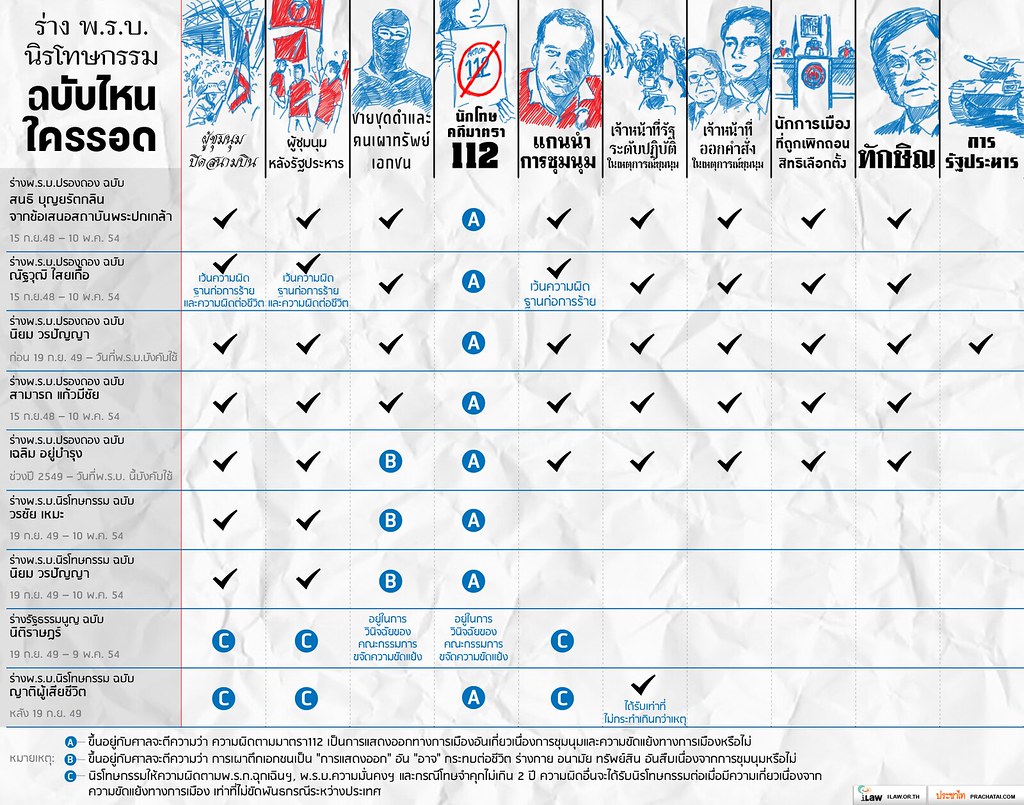
The authors of the drafts nearly all come from the governing Pheu Thai Party (PT). Red shirt leader and current deputy commercial minister Natthawut Saikua and coup-leader and now-opposition politician Sonthi Boonyaratglin may come from opposite ends of the political devide, but have presented similar amnesty drafts, with the main difference that "those who commit terrorist acts and acts causing death" are excluded in Natthawut's bill proposal. The former deputy prime minister and now newly demoted named labor minister Chalerm Yubamrung also throws in a draft of his own in a typically eager attempt to leave a personal mark on this issue, in which almost everybody - including Abhisit and Thaksin - are absolved. None of the bills include those imprisoned under the lèse majesté law.
Last week, another proposal for a reconciliation bill was introduced by a group that has been often neglected in the political infighting but was arguably most affected in the political crisis:
Relatives of those killed in the April-May 2010 crackdown on red-shirt protesters are to submit a "Worachai-plus" amnesty bill as parliament prepares to consider six other amnesty bills next month. (...)
"People from all colours will be absolved of any offence they committed or had committed against against them, except for core leaders," Ms. Payao [Akkahad, the mother of 25-year-old Kamolkade Akkahad, a medical volunteer who was killed inside Wat Pathum Wanaram on May 19, 2010] said of the victims' relatives' version of the bill.
The relatives will submit their five-page bill to Prime Minister Yingluck Shinawatra tomorrow, and to the parliament speaker on July 24, she said.
This bill, [Punsak Srithep, father of the 17-year-old Samapun Srithep, who was killed on May 15, 2010, on Ratchaprarop Road,] said, would allow judicial lawsuits to be pressed against persons or groups that killed people and/or damaged private property. The relatives' bill also does not prevent private entities whose properties were damaged in the unrest from launching civil suits against vandals or arsonists, he said.
"2010 victims' relatives push amnesty bill", Bangkok Post, July 15, 2013
The draft, coined by local media as the "People's Bill", has found in opposition Democrat Party leader Abhisit Vejjajiva an unlikely proponent. While he lauds it to be "the first amnesty bill that had been proposed with a reasonable and reconciliatory tone," parts of the proposal directly target him and his administration's role in the violent crackdown on the red shirt protesters in 2010 (both he and his former deputy Suthep are facing murder charges by the DSI on at least one count, if not even more). It comes as no surprise that his party supporters and other ultra-conservatives have criticized Abhisit for voicing his support, many questioning whether or not he actually read the entire thing. The opposition has not yet brought up a proposal on their own.
Meanwhile, the United Front for Democracy against Dictatorship (UDD), the mainstream red shirt umbrella organization, has voiced skepticism about the "People's Bill":
Prominent Pheu Thai politicians and Redshirts leaders, such as Mr. Weng Tojirakarn, Mr. Sombat Boon-ngarmanong, and Ms. Suda Rangupan, have accused Ms. Payao and Mr. Pansak of trying to slow down the process to pass amnesty bill by picking a fight with the powerful military.
According to those opposed to the ′Victims Families′ amnesty bill, the effort to free detained Redshirts protesters should be a priority over the need to prosecute the security forces. They expressed their fear that the military would never allow Ms. Yingluck′s government to pass such a bill, ruining the chance of any little gain there might be altogether, and might even launch a military coup in retaliation.
Some Redshirts also openly questioned the motives of Ms. Payao and Mr. Pansak, indirectly accusing them of being collaborators with the rival Democrat Party which, strangely enough, had expressed its support for the ′Victims Families′ amnesty bill.
"Fragmentation Among Redshirts Highlighted By Amnesty Debate", Khaosod Online, July 24, 2013
Instead, the UDD and the Pheu Thai Party are reportedly backing the draft by PT MP Worachai Hema, putting it top of the agenda for deliberation in parliament (even before the 2014 Budget Bill!) and ditching all other proposals - a move some observers say is to avoid uproar from the UDD, despite reports of dissatisfaction among certain groups within the fragmented movement. Under Worachai's bill, all political protestors will be granted amnesty - regardless of their political allegiance - while excluding the protest leaders and authorities responsible for the crackdowns.
August rings in a new political season that could get very heated very quickly: on top of the 2014 Budget Bill, the 2.2 trillion Baht (US$ 730bn) loan for infrastructure investments and proposed constitutional amendments, the amnesty bill will spark months of legislative tugs of war and wars of words (and potentially worse antics by the opposition outside and inside parliament like last year) - once again revealing how big Thailand's political divisions really are and that even a far-reaching amnesty will not be enough to close the gap.
Rohingya stuck in Thai detention vulnerable to traffickers
Originally published at Siam Voices on July 8, 2013 Over 2,000 Rohingya refugees are detained in Thailand as more reports about inhumane conditions, human trafficking and rape surface while efforts to relocate them to another country have so far failed. With a deadline looming very soon, they are now threatened to be stuck in limbo.
The Rohingya, an ethnic minority group denied citizenship and targeted in ongoing deadly persecution in Burma (partly incited by Buddhist monks), have fled on often overcrowded and frail vessels in the Andaman Sea in attempts to reach Malaysia or Indonesia, but more often than not land on Thailand's shorelines or are being intercepted by Thai authorities and either towed out back to sea again (euphemistically labeled by Thai officials as a "help-on"-policy) or deported back to Burma, since the Kingdom regards their status as those of illegal immigrants rather than asylum seekers.
In recent years, there were numerous reports of mistreatment by Thai officials during these "help-on"-procedures such as setting refugee boats adrift on the sea again and sometimes allegedly even removing the engine. Earlier this January, we reported on allegations that officials of the Thai Internal Security Operations Command (ISOC) have sold off 74 Rohingyas to human traffickers. Later in March, the Thai Navy faced allegations of shooting and killing as many as 20 refugees that were fleeing in the water from a failed boat-transfer. In both cases there were no impartial investigations and internal inquiries have come up without any results.
Those stranded or rescued by Thai officials - as many as 800 were found in human trafficker camps - are put into detention. According to statistics by Muslim humanitarian groups and published in the Bangkok Post, 2,018 Rohingya refugees are currently detained at 24 stations of vastly different standards, mostly located in the South of Thailand but also some as far as Chiang Rai in the North.

In the late May, Channel 4 News visited the second-largest detention center in Phang Nga and found the conditions to be dismal:
We got a good idea of just how serious these problems are when Channel 4 News accompanied a group of charity workers to an immigration lock-up in a Thai town called Phang Nga. The volunteers, who were members of a local mosque, told us the facility was severely overcrowded and they wanted us to see for ourselves.
(...) We found 276 male Rohingya living in extremely cramped conditions on the second floor – the majority crammed in one of two small “cages”. Inside, there was barely enough room to sit. There were a small number of others living between the two cells suffering from swollen feet and withered leg muscles. The cause was simple – lack of exercise. The men say they haven’t been let out in five months.
(...) This place typically hosts five to 15 men – not 276 – and the smell of sweat, urine and human waste was overpowering. The heat and mosquitos were oppressive and the men seemed to share a deep sense of despondency. A man told my translator that he was ready to tie his clothes together and use them as a rope to hang himself. In another conversation captured on film an inmate told us he had “nothing to live for”. Our translator was forced to plead with them not to kill themselves.
"The plight of Burma’s Rohingya Muslims in a Thai camp", by John Sparks, Channel 4 News, May 31, 2013
The report goes on to say that the Thai authorities are aware of the problems and "alternative arrangements are being identified." How these alternatives look (e.g. additional buildings) was not said. However, in some areas, plans for the construction of additional facilities were met with protests of locals.
In other locations, there are reports of female refugees falling victims to human traffickers and sexual assault:
[H]uman traffickers – both Rohingya and Thai – were able to gain access to the shelter in Phang Nga province soon after a group of about 70 Rohingya women and children arrived there in January. Korlimula, who was identified to Human Rights Watch as working for a Rohingya-Thai human trafficking gang, told Narunisa that he would reunite her with her husband in Malaysia for a fee of 50,000 baht (approximately US$1600).
On May 27, Korlimula helped Narunisa and her two children to escape from the shelter and took her to meet with other associates. Narunisa and her children were put on a pickup truck driven by a man, whom she later learned is a police officer at Khao Lak police station in Phang Nga province. The three of them were taken to six hideouts in the province, and in each case locked up against their will. At the final hideout on Koh Yipoon Island in Phang Nga province’s Kuraburi district, Korlimula repeatedly assaulted and raped Narunisa at knifepoint over the course of three days, from June 9 to 11. After that, Narunisa and her children were dumped on the street in Kuraburi district and the three of them made their way back to the shelter on June 18. Narunisa reported the rape case at Kuraburi district police station on June 18, and then filed a formal complaint against Korlimula on June 21.
"Thailand: Traffickers Access Government-run ‘Shelter’", Human Rights Watch, June 27, 2013
Such cases reveal that some human trafficker rings are colluding with local officials and politicians. Bangkok Post reports that both the human trafficker and the police officer have been charged.
The refugees have been waiting for at least six months, while Thailand is trying to find another country to take them in, but has yet to find one. The deadline of July 26 is running out, but the question about the fate of the more than 2,000 Rohingya refugees stuck in a legal limbo in Thailand's detention centers remains unanswered.
Thailand's Latest Cabinet Reshuffle: 3 Initial Observations
Originally published at Siam Voices on July 1, 2013 Cabinet reshuffles are a regular occurrence in politics and more often than not happen when the government is in need of a last-ditch turnaround. In Thailand, these kind of shake-ups come even more often than usual as various factions in the ruling party and also the coalition partners have to be kept happy to suppress any potential grumblings.
On Sunday, Thailand's King Bhumibol Adulyadej endorsed the changes to what is now the fifth Cabinet of Prime Minister Yingluck Shinawatra at nearly the halfway point of her tenure ever since she took over office in 2011. Currently, the government is under alot of fire:
Critics said the reshuffle was necessary because the popularity of the government and the ruling Pheu Thai party has plunged due to recent developments, including enormous losses from the rice-pledging scheme, a delay in an $11 billion water management megaproject and an unpredicted loss for the first time in 37 years of a parliamentary seat in a key Bangkok constituency.
"Thai government announces new Cabinet reshuffle", Associated Press, June 30, 2013
With the new line-up in place, here are three initial observations on the latest Cabinet reshuffle and what the implications are:
1. Yingluck's call of double duty as PM and defense minister
One of the most eye-catching changes involves the prime minister herself, as Yingluck Shinawatra will now act as defense minister as well. This has been a subject of speculation in past reshuffles, most recently last year (it obviously didn't happen).
The motives for her to take up the defense portfolio are the same and obvious: an attempt to counter-balance Thailand's powerful military. While the government and the armed forces have an uneasy relationship, the ties have been so far fairly stable since both camps are mostly keeping out of each other's affairs.
However, when it comes to the annual reshuffle of military officers the armed forces always had the upper hand, not least because of the Defence Ministry Administration Act, which was installed after the military coup of 2006 and allowed for a so-called Defence Committee to oversee the reshuffles. This panel consists of the defense minister, the deputy defense minister, the permanent secretary for defense, the supreme commander and the three armed forces chiefs - army, air force and navy.
This committee has always been dominated by military representatives, but the latest reshuffle moves to shift the balance of power. Crucially, the vacancy of the deputy defense minister is now filled by General Yuthasak Sasiprapha, the defense minister of Yingluck's first Cabinet until early 2012. With that spot filled, a new permanent secretary of defense endorsed last year and Yingluck herself now the new defense minister, politicians now have much greater representation on the committee and would 'only' need to win over a weak link among the military side in order to have the upper hand.
Whether or not this will actually play out has yet to be seen, as well as how the army will react to this strategic move.
2. Chalerm's 'bitter demotion' from deputy PM to labor minister
The highest-profile casualty of this reshuffle has to be the transfer of Chalerm Yubamrung from deputy prime minister overseeing national security matters to labor minister. Chalerm was charged with dealing with the ongoing deadly insurgency in the southern provinces. His attempts at dealing with the problem seemed half-hearted, considering he set up a command center in the capital Bangkok of all places and has personally visited the troubled region only once.
In his place is now former Justice Minister Pracha Promnok. True to form, Chalerm himself wasn't shy about voicing his displeasure:
[Last Friday] Mr Chalerm accused Pol Col Thawee [secretary-general of Southern the Border Provinces Administration Centre] of stabbing him in the back by reporting to Thaksin and Ms Yingluck about his involvement in illegal casinos - an accusation which he denies vehemently. (...)
"I curse everybody who made malicious accusations against me, that they face disaster for the next seven generations. (...) I am not afraid to be axed [from the cabinet] and I am willing to become an ordinary MP." (...)
He even turned his vehemence on Prime Minister Yingluck, saying that for the past two years she had remained aloof of all pressing problems, resulting in the political situation reaching a critical point.
"Chalerm unleashes his fury at cabinet snub", Bangkok Post, July 1, 2013
Even for a veteran politician known for his hotheaded outspokenness (also against his own ranks), this verbal 'friendly' fire was unprecedented. The Thai media was quick to highlight his "bitterness", considering his attempts to single-handedly work on a return for former deposed prime minister Thaksin Shinawatra.
3. Chaturon Chaiseng's return to the fold: revenge of the Thaksin veterans?
Chaturon Chaisang is a minister from the Thaksin administration and one of the 111 politicians banned after their Thai Rak Thai Party was dissolved in 2007. With the ban expiring last year, many of them are slowly coming back to the political fray, some of them also to the Cabinet: the aforementioned Chalerm, Thaksin's former PM Office Minister and spin doctor Suranand Vejjajiva came in last year to do the same for Yingluck; former Justice Minister Pongthep Thepkanchana could be one for the upcoming parliamentary fights over constitutional amendments as the new deputy PM; and Chaturon takes over as education minister. However, this is further ammo for the fiercest anti-government critics who will accuse PM Yingluck yet again of being solely her brother's puppet.
Other observations
In the light of the recent revelation of the true fallout of the government's populist and disastrous rice-pledging scheme and the poor handling of the Commerce Ministry, the axing of its minister Boonsong Teriyapirom was almost expected, while sparing his deputy and prolific red shirt leader Nattawut Saikua, who has recently raised some eyebrows for a promotional music video that was quickly removed again. And despite his antics last month, Deputy Prime Minister Plodprasop Suraswadi has apparently kept his job as well.
Thailand's materialistic monks pose worldly problems
Originally published at Siam Voices on June 21, 2013 The viral video depicting Thai Buddhist monks lavishing luxury goods while riding on a private jet is just the tip of the iceberg in an ever-growing list of the men in the orange robes behaving badly - or just like any other human with worldly problems.
Earlier this week, an YouTube video showing Buddhist monks sitting on a private jet plane sporting luxury bags, aviator sunglasses and listening to beats caused widespread attention, uproar and inevitable ridicule in Thailand and beyond. The depiction of the apparent lavish lifestyle runs against the strict and downright ascetic rules a Buddhist monk has follow once he decides to devote his life to the teachings of the Buddha.
http://www.youtube.com/watch?v=sANFgwoJeic
However, Thai newspapers regularly carry reports of Buddhist monks behaving badly. And a quick look at the headlines in the two English-language dailies The Nation and Bangkok Post for just this year so far alone make for impressive/depressing reading, depending how you look at it:
There are two reports of drug and alcohol abuse (January 15, May 28), two cases of physical assault or at least altercations (March 6, April 3), three counts sexual abuse of minors, including underage novice monks (April 11, June 18 and 19), at least one monk caught dining with a woman (February 8), a profanity-filled tirade by a monk on the SkyTrain captured on film (January 11) and countless allegations of improper use of donation money.
Thailand's national Buddhism agency, the National Office of Buddhism, already reprimanded around 300 monks for misconduct in 2012.
At the center of the current high-flying monks is Luang Phu Nenkham Chattigo - the one depicted in the video with the designer handbag - a 34-year-old, high-profile abbot from Si Saket province with good connections and a controversial past. He is regularly seen riding in Mercedes Benz or Rolls Royce limousines (like in this photograph taken in 2011 visiting refugees from the Thai-Cambodian border clashes - also note the numberplate with the auspicious numbers 9999), which are all legitimate donations as claimed by the monk and his followers. Also, he has allegedly been pictured lying next to a woman - on many levels an unthinkable breach of the celibate rule. His followers are dismissing this to be a malicious photoshop job. Oh, and you can also buy a statue of him for the auspicious sum of THB 99,999 (US$ 3,200) or a commemorative coin for THB 1,000 (US$ 32) - and then there's this...
Much of the temple's web presence consists of glowing homage to [Luang Phu Nenkham] who mixes Buddhist doctrine with claims of supernatural powers.
His personal site contends that he has walked upon water: He rose up and realized that his feet did not even touch the dust on the floor and stayed afloat when walking on the pond. And later in life, so goes the monk's lore, he meditated for three months inside a cave where a python would rest on his chest.
"Thailand reels at video of Buddhist monks' private jet journey", by Patrick Winn, GlobalPost, June 20, 2013
The problem with Thailand's Buddhism - a mixture of animism, superstition, Hinduism and the conservative Buddhist branch of Theravada of which officially almost 95 per cent of the population adheres to - is not solely Buddhist monks behaving badly (or just plain human as some would argue) or other contradictions many monks run afoul of.
There is, for example, the problem of increasing emphasis of materialism in daily religious practice by both the monks and the faithful:
The reformist monk Phayom Kallayano claims that Buddhism in Thailand is indeed 'facing a crisis'. The problem, according to Phayom, is that monks these days are allowing themselves to 'become slaves to material gains'. He notes that many monasteries want to lavish 'enormous sums' on building construction, 'in the hope of attracting public donations' from the new rich.
From: "(Post‐) Modernity, remaking tradition and the hybridisation of Thai Buddhism", by Jim Taylor, in: Anthropological Forum, Vol. 9 (1999), Issue 2, p 163–187
This practice, not unlike to the selling of indulgences in 16th century Christianity, against which German reformist Martin Luther was protesting in 1521 - was popularized by the Dhammakāya Movement and has been proven to be popular among the urban middle-class. The movement, regarded by many as a sect, is known to put on lavish mass-processions in the middle of Bangkok and also claimed last year the afterlife of the late Apple co-founder Steve Jobs.
Also, the claim by the aforementioned monks riding in luxury vehicles that these were donated show on one hand that some Buddhist monks indeed indulge in materialistic goods or at best could show the sheer naivety of some well-off well-wishers. In the latter case, such donations are simply unnecessary and pointless.
On the other hand is the apparent utilitarian approach to Buddhism by Thais, who participate in customs and rites uncritically, since it is simply part of daily life and a tradition that has been passed on without any questions.
As Mod darts from one donation box to the next she pauses to slip Bt100 (US$3.35) into a box placed before a statue of the elephant god Ganesha. When pressed on the significance of the Hindu deity in a Buddhist temple, she struggles to place him in a Buddhist context but agrees with her friends nevertheless that he is holy and we should not question such mystical things.
"The Crisis in Thai Buddhism", Asia Sentinel, February 1, 2013
Many more issues need in Thai Buddhism to be tackled - such as the role of monks in political conflicts, the utter disregard of female monks or the problematic attitude of monastic Sangha order itself - if it is to maintain moral credibility and not descend into irrelevance, otherwise the men in the orange robes will be increasingly seen as, to borrow a phrase from German poet Heinrich Heine, those who "publicly preach to fly economy, whereas they ride in their own jet!"
Thailand F1 plans hit major speed bump as Bangkok bans car racing
Originally published at Siam Voices on June 8, 2013
Thailand's plans for a nighttime Formula 1 Grand Prix in Bangkok in 2015 are in serious doubt after it emerged that Bangkok's Metropolitan Authority has banned car racing in the area the the race was planned for.
We have looked at the Thai government's plans to host a Grand Prix several times in the past, with a proposed track running through downtown Bangkok passing major landmarks such as the Grand Palace, Wat Phra Kaew, Sanam Luang and Democracy Monument.
Earlier this week we reported that these plans have been drawn up without the input of a particular group, which has now thrown a spanner in the works. Local residents and environmental groups have also voiced their opposition to the proposed Grand Prix, since the authorities have left them in the dark about the plans and the potential impact on the neighborhood.
We have raised a lot of questions regarding the ambitious plans by the government to bring Formula 1 to town. How would the already notoriously congested city cope with the shutdown of some of the capital's busiest roads? Is it really going to cost no more than $40m to host the race, with big local sponsors like Singha Beer and Red Bull reportedly willing to flip some of it? Is Thailand aready and capable of putting on a world-class sporting event or is it going to be similar to the FIFA Futsal World Cup disaster last year?
Well, we may not need to worry about these questions anymore:
But Bangkok's Metropolitan Authority has stymied the proposal with a law banning "car racing" from the zone.
"The law came into effect on May 16 prohibiting car racing in inner Bangkok because that area is a conservation for culture and arts," Kriangphon Pattanarat, director general of City Planning Department told AFP.
The law has been under discussion for two or three years, he said, adding it was not specifically targeted at F1.
"Motor Racing: Formula One stalls in Bangkok as law bans car racing", AFP, June 7, 2013
Thai federal officials like Minister of Tourism and Sports Somsak Phurisisak tried not to appear caught off guard by the apparent legislation effectively outlawing and killing the Bangkok F1 Grand Prix project, going on record stating they would not fight the ruling.
Furthermore, Somsak said that that the organizers are looking for alternative locations in Bangkok like the far Northern districts Muang Thong Thani and Chaeng Wattana, or elsewhere in the country like Nakhon Ratchasima, Khon Kaen and Phuket - all of which seem to be less attractive options.
Interestingly, no one has mentioned a racing circuit that is being currently built in Buriram, designed by Formula 1-track designer Herman Tilke, the newest brainchild of Newin Chidchob. The former (but very likely still influential) politician is now the man behind his football club Buriram United, which almost instantly became a national powerhouse within a few years. However, the 4.7km purpose-built road course will have a Category 2 rating from the motorsport governing body Fédération Internationale de l’Automobile (FIA). That means, it is not eligible to host Formula 1 races and would have to be modified and upgraded for that. But then again, the likelihood of a Pheu Thai Party-led government doing any business with Newin is very slim anyways due to their bitter political rivalry.
But with that the dream of bringing Formula 1 to Thailand at all seems to be over at this point, since anything other than Bangkok would be far from satisfactory for the organizers who are now scrambling to make a graceful exit from this. While skepticism was always lurking behind these plans, this whole campaign might have been the best shot Thailand had to realize its dream of hosting a Formula 1 Grand Prix - a dream it almost realized in 1939, but on that occasion it was canceled because of World War II.
F1 Bangkok Grand Prix plans face growing local opposition
Originally published at Siam Voices on June 3, 2013
Environmental groups and local residents are voicing their disapproval over the Thai government's ambitious plans for a Formula 1 Grand Prix in the middle of Bangkok under lights, citing various potential impacts on the neighborhood. But are these concerns valid and how far have the plans progressed?
We previously followed the government's plans to host a round of the pinnacle of motorsport, the FIA Formula 1 World Championship, in the middle of Thai capital ever since the first rumors of a bid surfaced in early 2012 and the potential costs were first tallied (estimated to be around $40m, with the state covering 60 per cent of it).
Despite an endorsement by F1 promoter and supremo leader Bernie Ecclestone late last year and the announcement by Thai officials of a 'done deal' in October, there hasn't been much movement since and no contracts have been signed. The final decision will come from the sport's governing body, the Fédération Internationale de l’Automobile (FIA), later this year.
Nevertheless, the project started to take some shape in late April with the revelation of the proposed track layout, showing a route that starts at the Grand Palace, passes key Bangkok landmarks such as Wat Phra Kaew, Sanam Luang, Pra Athit Road, Phan Fah Bridge, Democracy Monument and Ratchadamnoen Avenue, before closing the nearly 6km/3.7mi long loop at the Grand Palace again.

Furthermore, Bangkok has been shortlisted to hold a round of the Formula E Championship in 2014, a new FIA-sanctioned open wheel racing series powered with electric engines. However, while the championship rounds are solely held on inner city courses, these tracks won't be longer than 3 kilometers and the whole event - including practice, qualifying and race - will be held on one single day. Nevertheless, should Bangkok be selected to hold a race next year, it could be seen as a grand rehearsal for the Grand Prix in 2015.
(Side note: The Nation's business reporter bizarrely tweeted that Bangkok's GP bid has failed and thus got Formula E instead. After asking him about the reason, the reporter cited "advertisement rules due to tobacco sponsors", even though Formula 1 stopped carrying these several years ago - only then for him to admit that his tweet was based on a headline several years old but still refused to explain why he led with an outdated and highly misleading headline - read the whole conversation here.)
There are of course many questions left unanswered and a good number of these come from those that are most affected by the plans: the residents and local business owners in central Bangkok. As for most mega-projects in Thailand, this group of stakeholders is always approached last, if at all, as a recent gathering ofpeople affected by the race plans has illustrated:
Representatives from 20 communities convened on Saturday at Thammasat University's Tha Prachan campus to discuss the protection of historical sites on Rattanakosin Island from the F1 event.
"So far we have heard about this project from the media and others, but we have yet to see what is in the plan of the Ministry of Tourism and Sports. We have to see the proposal in detail and study the impact on historical sites and our way of life," said Parntip Likkachai, leader of Youth Banglamphu Community , who added that the communities' priority now is to create public awareness about the F1 race through a campaign this Saturday.
"Rattanakosin residents want to see F1 race plan", The Nation, June 3, 2013
"We didn't know anything about it from government agencies. We only learned about it from the media and social networks," community Theeraphol Kachachiva said on Wednesday. "We don't oppose an F1 event in Thailand. But it should not be raced on that route. It should be held elsewhere," Mr Theeraphol said.
"F1 backers feel the heat, as communities oppose plans", Bangkok Post, May 29, 2013
Srisakra Valibhotama, a prominent anthropologist and archaeologist, told Saturday's forum that it is "not appropriate" to hold a street race on Ratchadamnoen Avenue, whose name means "a path where the monarch travels" in Thai.
The protesters, especially residents in the 20 communities, are also worried about the noise caused by the racing cars at night as well as the vibration that may damage old trackside buildings.
A law restricts noise levels from cars on Bangkok streets to between 80 and 90 decibels, but the F1 cars would produce more than 100 decibels, said Thammasat second-year student Kasidit Kruthangphar.
"F1 race proposal riles Rattanakosin locals", Bangkok Post, June 2, 2013
Normally, when it comes to big government projects and policies by the current Pheu Thai Party, the opposition Democrat Party is quick to criticize (with various degrees of factual accuracy and shrillness). However, they have been pretty silent on this topic. Perhaps their close links to the main sponsors Singha Beer and Red Bull - as we have highlighted here - has increased their enthusiasm for the project.
A lot of valid concerns have been voiced (okay, apart from the "royal road" argument - that's ludicrous!) about the impact on the environment and local business. However, the overbearing impression is that no one actually really has an idea how all this will pan out, including the organizers themselves as they only have expressed general commitment.
Residents and fans are both questioning whether or not Thailand and its officials are capable of hosting a Formula 1 Grand Prix - and a city night race to boot - in Bangkok. Given the track record of issues surrounding such big projects - as recently seen with the debacle with Bangkok Futsal Arena not being built in time for the FIFA Futsal World Cup - the fear is that instead of a world class event we'll witness a world class embarrassment.
The fight against Thailand's archaic and militaristic education system
Originally published at Siam Voices on May 31, 2013 We have previously highlighted the dismal state of Thailand's education system and have explored the various reasons for its failures: from ridiculous questions being asked in the annual O-Net tests, questionable standardization of these tests, to poor PISA scores, horrendous English-language training and thus proficiency or virtually non-existent sexual education - there're a lot of problem spots that doesn't bode well for the present but also for the (near-)future of the country economically, but also culturally.
Previous governments have only thrown more money at the problem and Prime Minister Yingluck Shinawatra, while promising on a press conference after her election victory in 2011 to shift the focus on "life-long learning", her administration's best known education policy has been so far handing out free tablet PCs. But the problems lie much deeper.
The New York Times recently ran a story pointing to the root cause of our aching education system:
Thai students have an altogether different impression. In Thai schools, a drill sergeant’s dream of regimentation rooted in the military dictatorships of the past, discipline and enforced deference prevail.
At a public school in this industrial Bangkok suburb, teachers wield bamboo canes and reprimand students for long hair, ordering it sheared on the spot. Students are inspected for dirty fingernails, colored socks or any other violation of the school dress code.
(...) a system that stresses unquestioned obedience.
"In Thailand’s Schools, Vestiges of Military Rule", by Thomas Fuller, New York Times, May 28, 2013
This unquestioned discipline also reflects in the learning methods: rote learning, repetitious memorization is still widespread in Thai classrooms.
Another apparent factor is the enforced uniformity of Thai students: apart from the uniforms - Thailand is one of very few countries worldwide that requires even university students to wear uniforms - Thai schoolchildren have strict guidelines of hair cuts (boys have to wear a crew cut, girls can't grow their hair longer than the neckline and dyeing is absolutely prohibited) from very early on.
But this archaic regulation (dating back to 1972 during the military dictatorship of Thanom Kittikachorn) is undergoing a change since earlier this year, as the Education Ministry is proposing to relax these rules following a recommendation by the National Human Rights Commission, (NHRC) as we have previously reported and commented:
Hair on Thai school children’s heads has become a national policy issue. The student hair debate has been simmering and finally came to a boil after a schoolboy filed a complaint with the NHRC in December 2011. The complaint said that the school regulation prohibiting all hairstyles except the crew cut for boys and ear-lobe-length bob for girls is in violation of children’s human rights and that the schools allowing selected students such as those engaged in classical art performances to wear long hair is discrimination against other students subject to the hair rule. (...)
Since the student’s complaint to the NHRC in 2011 made the news, academics, policy makers, government officials and leading thinkers have weighed in with both pros and cons. The larger public recently jumped into the fray following the NHRC ruling in November 2012 and the decision by the education ministry just before Children’s Day. (...)
Perhaps these people are oblivious to the new reality that Thailand is in the midst of change - more young Thais are now getting a taste of questioning and blind obedience can no longer be taken for granted. Today’s Thai youth are rushing headlong into the 21st century, only to be pulled back by the hair - so to speak - by arcane rules. However, at least some Thai grown-ups are beginning to appreciate the children’s frustration. But enough to set them free?
"Thailand: What has hair got to do with children’s rights?", by Kaewmala/Siam Voices, Asian Correspondent, January 13, 2013
The aforementioned New York Times article also highlights another campaign to modernize education:
Late last year, a freethinking Thai high school student, Nethiwit Chotpatpaisan, who goes by the nickname Frank, started a Facebook campaign calling for the abolition of the “mechanistic” education system. Together with like-minded friends, he started a group called the Thailand Educational Revolution Alliance. He rose to national prominence in January after speaking out on a prime-time television program.
“School is like a factory that manufactures identical people,” he said one recent morning at his school, Nawaminthrachinuthit Triam Udomsuksa Pattanakarn, (...) Frank described the teachers there as “dictators” who order students to “bow, bow, bow” and never to contradict them.
"In Thailand’s Schools, Vestiges of Military Rule", by Thomas Fuller, New York Times, May 28, 2013
Indeed there is now growing resistance to the status quo in the classrooms and, surprisingly enough, has found an unlikely ally in current Education Minister Phongthep Thepkanjana - at least to the New York Times reporter. But at least a few changes are being implemented: aside from the hair cuts, the number of school hours will be shaved off from 1,000-1,200 to 800 hours per year, in line with UNESCO recommendations.
But there needs to be a lot more to be done - like the lacking reading culture despite Bangkok being named World Book Capital 2013, the problem of corruption for school admissions while also planning to close down smaller schools or also the abusive culture of rite-of-passage rituals among first-year university students - all these and much more need a fundamental thorough overhaul not only to the curriculum, but also to the attitude towards teaching and preparing our children for the future to lead and not to follow.
Thailand: Ultra-conservatives hijack "Thai Spring" moniker
Originally published at Siam Voices on May 17, 2013 Thailand's political climate could be heating up again after the Prime Minister's Mongolia speech has caused strong reactions, especially from anti-government groups. A new online group now has now claimed the 'Thai Spring' moniker to denounce the government, but it has very little to do with its bigger counterpart in the Middle Eastern revolutions.
When Prime Minister Yingluck Shinawatra went to Mongolia's capital Ulan Bator in late April, many were expecting yet another trip abroad to drum up economic ties with foreign states and private investors. However, speaking at a conference of democratic countries, she addressed some very sensitive issues for the first time since the beginning of her tenure in 2011.
In her speech, Yingluck praised her brother and former prime minister Thaksin's political achievements (while deliberately overlooking his faults and wrongdoings) during his rule, acknowledged the red shirt protesters who "fought back for their freedom" and gave "their lives defending democracy".
She also condemned the 2006 military coup that ousted Thaksin and said "elements of anti-democratic regime still exist" and are still working against her, explicitly mentioning "the so called independent agencies have abused the power."
For once, Prime Minister Yingluck Shinawatra - until then always striking a conciliatory tone and a soft approach - made a politically committed speech and was ready to take sides. She did not shy away from sad truths (e.g. the military drafted constitution of 2007), while highlighting her government's populist policies and those of Thaksin - something she could have done much earlier.
(READ MORE: Bangkok Pundit's analysis of Yingluck's Mongolia-speech)
The strong reactions by her political opponents suggest Yingluck has struck a nerve: the controversy around the misogynist insult by a Thai Rath cartoonist and the ill-advised lawsuit against him by the PM and the even more ill-advised rampage by the ICT minister were just one of many different verbal flash points following her speech.

This week, another front has opened up in the reactionary fallout to Yingluck's Mongolia-speech:
A new website has been launched, Thai Spring, where people can voice their opposition to the Yingluck Shinawatra government, retired police officer Vasit Dejkunjorn and former senator Kaewsun Atibodhi said on Thursday.
Describing himself as a person who adheres strongly to the principle of a democratic administration under the monarchy, and who has experienced many political eras in Thailand, Pol Gen Vasit said he was aware there are groups of people trying relentlessly to undermine the highest institution in the country.
Those people have a plan to take over Thailand and change its administrative system, and he would not stand by and allow this to happen, he said. (...)
"It is a website, <http://www.change.org/users/thaispring>, where they can sign in and express disapproval of the prime minister's speech in Ulan Bator. "More than 10,000 people have signed on to the website so far to express their opinion that in delivering that speech the prime minister acted wrongly. (...)
Pol Gen Vasit called for the government to review its role, otherwise the "Thai Spring" movement would develop, in the same way that the "Arab Spring" phenomenon had led to anti-government protests by huge numbers of people.
"Anti-govt 'Thai Spring' website opened", Bangkok Post, May 16, 2013
The two men behind the campaign, Vasit Dejkunjorn and Kaewsun Atibodhi, are noted ultra-royalists and anti-Thaksinites respectively. Vasit has attended several pro-monarchy rallies in the past, while Kaewsun often publicly slammed Thaksin on the stage of the yellow shirts gatherings and investigated against his administration after he was appointed to a post-coup committee. So, it's pretty clear where these two are coming from politically - as is their the often regurgitated claim of the Yingluck-Thaksin campaign to overthrow the monarchy.
What stands out in this case are the means of their protest: this ultra-conservative group is starting their anti-government campaign online. Unlike what is erroneously reported, "Thai Spring" does not have a self-hosted website (yet) but is rather a group on the Thai section of Change.org, an online petition platform that normally avoids overly politically partisan campaigns.
The petition itself called "ร่วมลงชื่อปฏิเสธปาฐกถาอูลานบาตอร์ของนายกรัฐมนตรี" ("Petition to Denounce the Prime Minister's Ulan Bator-Speech") has at the time of writing reached over 14,000 signatures and have explained in a long open letter how PM Yingluck is just a puppet of the exiled Thaksin, how they're going turn the country upside down, and how all the media in their pockets, comparing at lengths the PM, the government, the ruling party to Kim Jong-Il and North Korea*. Of course, they also claim to speak on behalf of all Thai citizens.
No doubt the attention-grabber here is the name 'Thai Spring' this group has hijacked in order to mimic the 'Arab Spring', which has fundamentally changed several Middle Eastern and North African countries and is still ongoing after over two years. But looking at the two sides here, they couldn't be further apart from each other**:
The 'Arab Spring' was in part sparked by a disenfranchised youth stifled with high unemployment and fed up with decades-old authoritarianism. On the other hand, these men behind the so-called 'Thai Spring' represent an elitist, reactionary force that see their vision of Thailand endangered by Thaksin Shinawatra - who without a doubt is not a democrat either, but (unwittingly) enfranchised a largely neglected rural population with political conscience - and want to stop it with all non-democratic means at all costs (e.g. endorsing a military coup), even at the cost of democracy itself!
This could signal yet another political (re-)entrenchment, as the opposition both in and outside parliament have been clearly agitated by Yingluck's speech, which could be seen as a battle cry for a stronger push in the upcoming political challenges later this year such as the charter amendments, the reconciliation bills, but also the court verdict in the Thai-Cambodian border dispute.
The relative calm over the past years could be pushed aside by the reemergence of the heated political polarization and a further escalation between the two fractions that have diametrically opposing visions about the future of Thailand's rule and its structure. But with the hijacking of the 'Thai Spring' by the ultra-conservatives it has already been made clear: this spring does not signal a fresh new start.
*On the comparison to North Korea, here's another quote from the open letter: "If you pay a visit to North Korea you will witness the omnipresence of portraits of the leader. In Thailand it is the same. These two likeminded families have thus been sending their followers and subordinates to infiltrate all strata of their respective societies." Hmm...!
**More on the (un-)likelihood of an 'Arab Spring'-style uprising Thailand hopefully in a future post.
Tongue-Thai'ed! Part XX: Of protester 'garbage', ancient kings and deputy PMs
Originally published at Siam Voices on May 12, 2013 This is part XX of “Tongue-Thai’ed!”, in which we encapsulate the most baffling, amusing, confusing, outrageous and appalling quotes from Thai politicians and other public figures – in short: everything we hear that makes us go “Huh?!”. Check out all past entries here.
Chiang Mai will host the 2nd Asia-Pacific Water Summit this week. Leaders from 50 different countries and countless of other participants from academia, the public and private sector are expected to come to discuss anything related with water management from irrigation to security - and one Thai deputy prime minister has shot off his mouth again, but not the one you might be thinking about!
Thailand of course has had a lot of experiences in recent years with the liquid element, in particular with the 2011 flood crisis as unprecedented amounts of rain and the inadequate responses by the Kingdom's dams have caused widespread floods across the country, killing hundreds of people.
The national government relief efforts were hampered by constant squabbles with the local Bangkok Metropolitan Authority. However, it was then science minister and overseer of the flood relief efforts Plodprasop Suraswadi who cemented the government's image of a bumbling mess when he jumped the gun before anybody else and ordered on national TV a premature evacuation order for a local Bangkok district - only for it to be called off later by somebody else.
Since then, Plodprasob lost his place at the Science and Technology Ministry and has been appointed deputy prime minister (one of six) overseeing water management and also in charge of a THB 350bn (US $11.8bn) budget for flood prevention projects.
Now Plodprasob is heading this week's water conference and is hellbent to not only show Thailand's commitment to water management and flood protection, but also to show the city of Chiang Mai as a splendid conference venue. And everything seemed to go well, if it weren't for those pesky environmental and water preservation activists that have announced to protest at the Water Summit...
สำหรับกรณีที่อาจจะกลุ่มมวลชนที่ทำงานด้านทรัพยากรน้ำมาเคลื่อนไหวชุมนุมและแสดงความเห็นระหว่างการประชุมในครั้งนี้นั้น นายปลอดประสพ กล่าวว่า หากมีการชุมนุมประท้วงจะให้เจ้าหน้าที่ตำรวจทำการจับกุมดำเนินคดีทั้งหมด เพราะสถานที่จัดการประชุมในครั้งนี้ไม่ใช่สถานที่จัดการประท้วง ซึ่งขอเตือนผู้ที่จะชุมนุมประท้วงว่าอย่ามาเด็ดขาด จะสั่งจับให้หมด [...] จะมีก็แต่จัดคุกไว้ให้เท่านั้น และจะไม่มีการพูดคุยเจรจาใดๆ ทั้งสิ้น จับอย่างเดียว [...]
Concerning the potential protests by water conservationists' groups against the summit, Plodprasob said that in that case that the police should arrest them all, because this summit this not meant for protests. He urges protesters not to come at all, since they are going to be arrested [...] and detained right away without any warning [...]
“มาก็จับ ทำผิดกฎหมายก็จับ มันไม่ใช่ที่ที่จะมาประท้วง ฝากบอกไปด้วย มาประชุม [...] ไม่มีที่ไหนใครเขาไปทำร้ายใคร บรูไนเขามาพูดเรื่องบรูไน อิหร่านเขาก็มาพูดเรื่องอิหร่าน เกาหลีเขาก็มาพูดเรื่องเกาหลี คุณจะมาประท้วงอะไร อย่ามานะ ทำผิดกฎหมาย สั่งจับเลย และคนเชียงใหม่ก็ไม่ควรปล่อยให้พวกขยะเหล่านี้มาเกะกะ คุณเขียนอย่างผมพูดเลย กล้าเขียนหรือไม่” รองนายกรัฐมนตรี กล่าว
"When they come, they'll get arrested. When they break the law, they'll get arrested. Let them [the protesters] know, [...] nobody [coming to the summit] is coming to harm us - the Bruneians are gonna talk Bruneian issues, the Iranians about Iranian issues, the Koreans about Korean issues - what are you protesting against?! Don't come here! Break the law and you'll be arrested right away! And all the people of Chiang Mai should not allow this garbage to obstruct [us]. You can write it down like this - I dare you to!" said the deputy prime minister.
"‘ปลอดประสพ’ตรวจสถานที่ถกผู้นำด้านน้ำเอเซีย-แปซิฟิก ว๊ากห้ามม็อบป่วนเด็ดขาด : ข่าวสดออนไลน์", Khao Sod, May 12, 2013 - translation by me
YOU BET WE WILL WRITE IT DOWN HERE LIKE THIS!!!
Furthermore, the Prime Minister's Office Minister Niwatthamrong Bunsongphaisan was quoted urging protesters not to, um, protest for the sake of putting "national reputations first because this summit is an academic meeting of global importance," echoing many countless past examples (e.g. Prayuth) that put 'national image' above any substantial discussion of various issues.
And the deputy prime minister Plodprasob is further going to uphold Thailand's image and promote the Kingdom's values and history to international delegates by - and I'm not making this up - by taking part in a large-scale stage performance playing the 13th century Lanna King Mangrai - and the 'best' part: he's going to be in full costume...!

According to media reports the play will the tell the story of King Mangrai's role saving the the ancient city of Wiang Kum Kam from floods, whereas the historical King Mangrai simply moved the capital of the Lanna Kingdom to what nowadays is Chiang Mai. No word on if and how much money of the THB 350bn flood prevention budget has gone into this production.
Unsurprisingly, the (unflattering) sight of a government minister in charge of flood prevention playing an ancient king apparently known for his flood prevention efforts is just one single magnet for very obvious ridicule. Others criticize the potential historical misrepresentation and the role of the King being grossly miscast - to which the deputy minister also has a blunt answer...!
"ส่วนเอ็นจีโอกังวลการแสดงบิดเบือนข้อมูลนั้น คนที่พูดเรื่องนี้เป็นคนที่น่าเกลียดที่สุด ผมเล่นตามบทประพันธ์ ตามประวัติ ซึ่งทำเป็นลายลักษณ์อักษร จะไปบิดเบือนอะไร เขาไม่ได้นิสัยโกหกอย่างพวกคุณ [...] กรุณาอย่าถามผมเลย ผมรู้สึกรังเกียจที่จะรับฟังและตอบ" นายปลอดประสพ กล่าว
"To those NGOs that whine the play will twist historical facts, those are the most despicable! My role will be according to the play and based on history, what's there to twist?! They're not lying like those [the NGO activists]! [...] Please don't bother me with such questions, I feel annoyed to listen and answer to those," Plodprasob said.
"'ปลอด'ฉุน!อัดคนต้านเล่น'พญามังราย'", Khom Chad Luek, May 15, 2013
For somebody who is very concerned to put on a good show to the world, Plodprasob has certainly already made quite an impression before the summit week. In a normal world his antics would have led him to exit stage left - but since this is Thailand, it might take a few more chapters until the final curtain falls on him.
Tongue-Thai'ed! Part XIX: An insult to the PM, a libel suit and an avalanche of poor decisions
Originally published at Siam Voices on May 10, 2013 This is part XIX of “Tongue-Thai’ed!”, in which we encapsulate the most baffling, amusing, confusing, outrageous and appalling quotes from Thai politicians and other public figures – in short: everything we hear that makes us go “Huh?!”. Check out all past entries here.
In her tenure for almost two years now, Prime Minister Yingluck Shinawatra generally comes across as a restrained, non-aggressive politician who generally shys away from personally addressing controversial issues or being confrontative - mostly for the sake of a shaky stability.
However, many saw Yingluck's recent speech in Mongolia as the end of Ms. Nice PM. In her speech at a conference of democratic countries in late April she addressed the importance of democracy in Thailand, praising the red shirts who have elected her into office and her brother and former prime minister Thaksin for his achievements (overlooking his wrongdoings) before he was toppled by the military and other forces in what Yingluck called an "undemocratic regime".
For many observers, this was an uncharacteristically sharp and committed speech (more on the speech itself in a future Siam Voices post). For her critics, it's the ultimate proof of her being solely Thaksin's puppet and they have been taking to social media platforms to yet again vent their anger at the prime minister, her government, her brother, the red shirts and everybody else they perceive as a threat to the nation.
One of these was "Chai Ratchawatra" aka Somchai Katanyutanan, a well-known political cartoonist at the Thai language daily Thai Rath, who commented on his personal Facebook account:

โปรดเข้าใจ กระหรี่ไม่ใช่หญิงคนชั่ว กระหรี่แค่เร่ขายตัว แต่หญิงคนชั่วเที่ยวเร่ขายชาติ
Please understand: whores are not evil. They just sell their bodies. But an evil woman is going around selling her country.
Facebook post by "Chai Ratchawatra", approx. May 1, 2013
This vile and nasty remark spread around Facebook very quickly among both pro- and anti-Yingluck camps and has unsurprisingly sparked condemnation and commendation respectively (and in the light of such a horrendously sexist insult, Thailand's leading feminists have remained quiet again (and again).
The first to react were sections of the red shirts that have almost immediately converged with 100 people to the Thai Rath headquarters to demand an apology and also bizarrely laid a funeral wreath with the cartoonist's name on it, which could be perceived as a threat. Also, the ruling Pheu Thai Party slammed Chai's slandering, saying the cartoonist "lost his mind."
What then followed though is a bizarre series of poor decisions and even poorer remarks from across the political spectrum that warrants this XXL-sized "Tongue-Thai'ed!" in three acts - this is going to be a long one...!
Act 1: The MICT's wrathful verbal rampage
Shortly after the controversy was about to fade, Prime Minister Yingluck (again unprecedentedly) filed a lawsuit against Chai Ratchawatra for defamation last Friday. As understandable the suit is, it did make the head of the Thai government look thin-skinned (no matter how vile and sexist the insults are) and the timing couldn't have been any worse: of all days, that Friday was also World Press Freedom Day and that move also reminds of Thaksin's past rigorous handling of critical press.
However, the government's enemies got even more fodder for their fake sanctimonious outrage in the guise of Anudith Nakornthap, Minister of Information and Communications Technology (MICT), who went on record pledging to shut down any websites that contains criticism of the PM. Obviously, he had to defend his stance...
The Information and Communications Technology Ministry had been misunderstood and accused of blocking people's right to free speech following attacks from "ill-intentioned people", Minister Anudith Nakornthap said.
The ministry had no mandate to shut down websites on its own, and would normally need a court order to do that, he added. However, defamatory remarks about the prime minister could cause a site to be immediately suspended. (...)
Meanwhile, the ICT minister confirmed reports of his vow to take action related to criticism against Yingluck. He insisted he was doing his duty and that he had the authority to do so.
He urged anyone who finds offensive messages on the Net to report them so the ministry could ask the web administrator to immediately remove the messages.
"My right to close anti-PM websites, minister claims", The Nation, May 8, 2013
This is in line with his previous anti-free speech remarks to crack down on dissenting voices "more stringently" and "by enforcing the law to the fullest", mainly lèse majesté-related content. Anudith also previously went on record threatening to criminalize even simple Facebook 'likes' and 'shares', probably now by his logic also opinions critical against the prime minister, who has given her blessing to Anudith's vowed online crackdown - so far, there have been no reports of blocked websites or netizens hit by lawsuits.
Act 2: The Democrat's sanctimonious outrage
The MICT's vow of course created a huge opportunity for the Democrat Party to condemn the PM and the MICT for "violation of democratic principles", spearheaded by former prime minister and party leader Abhisit Vejjajiva and deputy spokesperson Malika Boonmeetrakul. This is the same Democrat Party with the same persons that have allowed the MICT during the tenure of the Abhisit administration to create the 'Cyber Scouts' volunteer force for monitoring dissenting voices online and to draft a worse version of the Computer Crimes Act than we already have.
Their party members have also gone on record endorsing online censorship, especially in lèse majesté cases ,so much so that the aforementioned Malika Boomeetrakul has called for a complete shutdown of social media sites like Facebook and Twitter in the most extreme cases - and that coming from a former journalist, no less!
Act 3: The self-inflicted hack attack
But the absolute climax in this saga was an almost self-inflicted blow for the prime minister and the MICT:
Hackers got into the PM's Office website (www.opm.go.th) yesterday and posted (...) the picture of Yingluck laughing, captioned: "I know I am the worst Prime Minister ever in Thai history." The hacker also changed a menu item listing Yingluck's Cabinet on the top left-hand corner of the page with a very rude sentence.
"Hackers name PM the worst ever in Thai history", The Nation, May 9, 2013
Anudith's words have goaded reactionary hackers to take over one of Thailand's official websites, which have been notoriously unsafe and in some cases a cesspool of potential malware, apart from being bloated with useless graphic and auto-play music elements. This incident is a big embarrassment for the authorities, since the MICT has just recently announced an overhaul of government websites - guess they better start sooner rather than later!
The 'very rude sentence' has been widely withheld in Thai media outlets (probably fearing Anudith's and the MICT's wrath). The line is "I'm a slutty moron", or as the as the Bangkok Post has wittingly paraphrased it: "The message made derogatory remarks about the premier's intelligence and sexual morality."
Having learnt from the debacle after Yingluck's Twitter account was 'hacked' in October 2011 and not finding the suspect until he turned himself in, the authorities have already quickly identified the hacker suspect and he is reportedly going to surrender to the police.
That is hopefully going to be the last chapter in this undignified saga, in which nobody really looks good - from the initial nasty sexist comment by the Thai Rath cartoonist, the PM's lawsuit against him and the MICT's verbal crackdown, the opposition's misplaced outrage to the hacked government website.
This is the partisan ridiculousness in its purest concentrated form that blows a side-shows out of proportions and also detracts from the most important issue(s) here: Prime Minister Yingluck's speech itself!
Bangkok approves track route for Formula 1 city night race
Originally published at Siam Voices on April 29, 2013
Bangkok has inched another step closer to hosting a Formula 1 race in Thailand after the approval of a track route in the old part of the capital. But does the city have the infrastructure to host an event of this size?
We have documented Bangkok's bid to host a round of the FIA Formula One World Championship since the first concrete rumors emerged in early 2012, fueled by strong financial backers such as the energy drink maker and world championship winning F1 team owners Red Bull. Speaking of costs, we then looked at the potential costs to Thailand and the city to host a race weekend in the middle of the city the bill came in at about estimated to be around $40m, not including the cost of the venue itself.
What has been noticeable in this story is how vocal the Thai organizers have been - going ahead with the announcement last October that the Grand Prix is as good as a "done deal" - and the silence of the governing body Fédération Internationale de l'Automobile (FIA) and the promoting Formula One Management (FOM), headed by Bernie Ecclestone, who normally don't like when local organizers jump the gun. Despite all that, F1 supremo Ecclestone gave the Thailand Grand Prix his blessing, aiming for an appearance on the 2015 calendar.
It would be the third race in Southeast Asia, with Sepang in Malaysia and Singapore being the other two. Singapore is currently also the host of the only night race on the calendar.
Local organizers have long expressed their desire to have Formula 1 cars race in the streets of Bangkok at night. Last Friday, the Sports Authority of Thailand announced that it has now finalized the track layout, and here it is:
The almost 6km-long city street circuit is essentially an extended and updated version of the planned track route for the 1939 Bangkok Grand Prix, which was cancelled due to World War II. It features 12 c0rners (seven right, right left), and typical for a street course many of these are 90 degree turns. The course will lead drivers past many iconic landmarks in the old downtown part of Bangkok such as Wat Phra Kaew, Sanam Luang, (to a certain extent) Khao Sarn Road, around Democracy Monument and most impressive of all it will go right around the Grand Palace.

The route would give spectators and TV viewers the chance to see several tourist spots such as the Grand Palace, Victory Monument and Temple of Dawn, [Kanokphand Chulakasem, governor of the Sports Authority of Thailand] said.
Makeshift stands could be built in several areas along the route and would be able to accommodate about 150,000 people, according to the governor.
"As the starting and finishing point would be on the bank of the Chao Phraya River, we may be able to build the main stands in the river. It would also be convenient for transportation of equipment," he said.
"Only a small group of residents would be affected by the proposed route."
"Green light for race route", Bangkok Post, April 26, 2013
The start and finish is proposed to be at the Royal Thai Navy Dockyard next to the Grand Palace, which begs the question where the pit lane and paddock will be built, since there's only a medium-sized parking lot with a pavilion in the middle of it next to a couple of tennis courts - and the grandstands are supposed to be built on the river behind the pit buildings...?
Naturally, there are a lot of new questions that need answering on top of the already existing ones: How severe will the effects be on the residents and traffic itself considering it takes weeks to close off the streets in order to build the circuit and to dismantle again? Bangkok's traffic problems are notorious. How many roads do need to be repaved, how many traffic 'islands', electrical poles and drainages removed and most of all: how many million baht will this spectacle actually cost?
FIA officials reportedly visited the city earlier this year to see the proposed route and the location itself first hand, but have made no comments yet, as this track needs to pass inspection to meet FIA safety standards. Should this inner city plan be fall through, Thai officials still have a plan B for an alternative venue, which will be in the less-central, less accessible and frankly less attractive outskirts of Muang Thong Thani or Chang Wattana.
The final decision on whether or not Bangkok will host the Thailand Grand Prix will be made in October 2014, when the FIA will decide on the 2015 calendar.
h/t to a Twitter follower
Thailand lifts ban on Preah Vihear border conflict documentary
Originally published at Siam Voices on April 26, 2013 Earlier this week, the Thai independent documentary “Boundary” or “ฟ้าต่ำแผ่นดินสูง” (literally “Low heaven, high ground”) on the Thai-Cambodia border dispute around the ancient Hindu temple Preah Vihear was banned from commercial release by a sub-committee of the Thai national Film and Video Board (see previous coverage) for endangering "national security and international relations" and misinforming an unknowing audience about ongoing legal cases. The Film and Video Board lifted the ban on Thursday, citing a "technical mistake".
Filmmaker Nontawat Numbenchapol follows a young Thai ex-soldier who took part in the bloody crackdown on the anti-government red shirt protests 2010 on his way back to his home village in Sisaket province near the border, where the conflict between Cambodia and Thailand was heating up. The movie also features accounts from locals from both sides of the border and mentions Thailand's other conflicts, such as the insurgency in the Deep South.
Thailand and Cambodia have been in a territorial dispute since the ownership of the ancient Preah Vihear temple was awarded to Cambodia in 1962 by International Courts of Justice, where both countries testified last week in seeking a new ruling on the 4.6 sq km area around the World Heritage site from the ICJ. A verdict is expected in October later this year.
In recent years the conflict has escalated into armed clashes between the two countries. Forty people have been killed since June 2008, hundreds injured and thousands of locals displaced. The Preah Vihear issue is also constantly exploited by Thai ultra-nationalists to drum up anti-Cambodia sentiment and pressure military and politicians, driven by the fear of "losing territory to the Khmer".
Reports indicated that the censors might have taken offense at a lot of things in the documentary, including soundbites of Cambodian soldiers and villagers criticizing their Thai neighbors, the stated number of casualties of the 2010 red shirt protests (100 vs. officially 84) and footage from the clashes.
"Boundary" would have been the third movie banned from commercial release in Thailand, along with 2010's "Insect in the Backyard" and 2012's "Shakespeare Must Die". The ban unsurprisingly drew much attention and condemnation, especially from foreign media - such as* AP, The Guardian or The Hollywood Reporter - and on social networks. The movie was screened at small movie festivals in Thailand, and also at the Berlinale earlier this year.
Now it seems things have turned, according to the filmmaker on the movie's Facebook page on Thursday evening:
Ban Verdict Overturned: “Boundary” has been cleared to screen with 18-plus rating
The Film and Video Board, attached to the Office of Cultural Promotion, contacted the filmmaker of Boundary on Thursday to apologize for the “technical mistake” regarding the ban order on Tuesday, April 23. The filmmaker was informed that the ban order was the decision of a sub-committee that in fact has no authority to issue such verdict. Only the main committee has the jurisdiction to do so. When the main committee saw the film on Thursday, April 25, they decided to let the film pass. Also, before banning any movie, the committee is required to allow its director to defend himself, but that didn’t happen on Tuesday.
However, the censors asked the director to remove two seconds of ambience sound in an early scene. That scene is the New Year’s celebration at Ratchaprasong Intersection during which an MC announces on stage: “Let’s count down to celebrate HM the King’s 84th anniversary”. The censors expressed concerns that this might lead to misinterpretation.
The filmmaker realizes that the sound has no significance to the story of the film and agreed to mute it.
The sub-committee who banned the films cited several inappropriate issues and presentation, but the main committee does not object to any of them. Besides those two seconds of audio, the entire film remains intact.
Nontawat Numbenchapol 25 April 2013
(emphasis by me)
A couple of interesting points here: Why does the documentary get an 18+ rating? Also, that part that is to be muted also seems odd - why did the censors take so much offense to it when it bears no significance to the movie? How severely misinterpreted can that part (in Thai "เรามาร่วมเคาท์ดาวน์และร่วมฉลองให้พระบาทสมเด็จพระเจ้าอยู่หัว มีพระชนมายุครบ 84 พรรษา" ) be that it needs to be muted?
What went wrong at the Thai Film and Video Board that allegedly a subcommittee was able to order a ban, while it had no power to do so? And how much did the public backlash affect yesterday's decision?
No details for a release date and locations have been released yet.
* the Committee to Protect Journalists (CPJ) also published a press release condemning the ban on Thursday night Bangkok time - just six hours after the ban was already overturned...!
Thai documentary on Preah Vihear border conflict banned
Originally published at Siam Voices on April 24, 2013 A Thai independent documentary about the disputed border region with Cambodia and the ancient Hindu temple Preah Vihear has been banned from screening in Thailand for "national security" reasons, according to the filmmaker.
The movie "Boundary" or "ฟ้าต่ำแผ่นดินสูง" (literally "Low heaven, high ground") by Nontawat Numbenchapol revolves around a young Thai soldier from the violent crackdown on the anti-government red shirt protests 2010 on his way back to his home village in Sisaket Province near the border and local life with the dispute looming in the background.
On Tuesday, the movie's Facebook page posted an update that the movie has been banned from screens nationwide and cites the authorities as saying:
ผลการตรวจพิจารณาภาพยนตร์ ของคณะอนุกรรมการพิจารณาภาพยนตร์และวีดีทัศน์ เรื่องฟ้าต่ำแผ่นดินสูง ไม่อนุญาตให้เผยแพร่ในราชอาณาจักรไทย ด้วยเนื้อหาที่ขัดต่อความมั่นคงของชาติ และความสัมพันธไมตรีระหว่างประเทศ และการนำเสนอข้อมูลบางเหตุการณ์ยังอยู่ในขั้นตอนการพิจารณาของศาล โดยไม่มีบทสรุปทางเอกสาร
“The Film and Video sub-committee [attached to the Ministry of Culture] do not permit the documentary film “Boundary” (Fah Tam Pandin Soong) to be screened in the Kingdom of Thailand. The film’s content is a threat to national security and international relations. The film presents some information on incidents that are still being deliberated by the
Thaicourt and that have not yet been officially concluded.”Facebook update by Nontawat Numbenchapol, April 23, 2013 - translation by Nontawat, emphasis by me
The area around the ancient Hindu temple has been at the center of a long territorial dispute between Cambodia and Thailand since the ownership of the temple has been awarded to Cambodia by the International Court of Justice (ICJ) in 1962. The conflict heated up again in recent years, escalating in armed clashes on the border in 2011. Forty people were killed, hundreds injured on both sides and thousands of locals have been displaced.
The 4.6 sq km area remains disputed territory with both countries drawing up different border lines. Last week, the two countries went to court again at the petition of Cambodia to the ICJ to reinterpret the vicinity of the original 1962 verdict. A judgement is expected in October 2013.
The movie has already been screened at small independent theaters and movie festivals in Thailand, and also at the Berlinale earlier this year - one of the major international movie festivals.
The Bangkok Post has listed some points in the film that might have caused issues with the censors:
The film also includes YouTube footage of Thai soldiers in action during a border skirmish in 2011, a survey of damage from Cambodian shellings, and a long monologue from a Cambodian soldier who criticises Thailand. (...)
One concern is a caption explaining that there were "nearly 100 deaths" during the red-shirt crackdown at Ratchaprasong on May 2010. The official figure is 89.
"Preah Vihear documentary banned", Bangkok Post, April 24, 2013
Nontawat defended his documentary, saying that...
จากย่อหน้าข้างต้นคือส่วนหนึ่งของเหตุผลที่ภาพยนตร์ฟ้าต่ำแผ่นดินสูง ไม่ได้รับอนุญาตให้เผยแพร่ในราชอาณาจักรไทย โดยข้อมูลทั้งหมดที่ผมได้จากการลงไปยังพื้นที่จริงจากมุมมองของประชาชนในพื้นที่จริงที่อาศัยอยู่บริเวณชายแดน ไทย - กัมพูชา ที่ได้รับผลกระทบโดยตรงจากข้อพิพาทกรณีเขาพระวิหาร ส่วนหนึ่งทางผู้สร้างต้องการให้ภาพยนตร์เรื่อง ฟ้าต่ำแผ่นดินสูง เป็นพื้นที่การแสดงออกให้ประชาชนในพื้นที่ที่ได้รับผลกระทบจริงๆได้แสดงมุมมอง ทัศนคติ และ ความคิดเห็นที่พวกเค้าไม่มีโอกาสได้สื่อและได้พูดออกมาสู่สาธารณชนได้รับรู้ ประชาชนควรมีสิทธิได้พูดในสิ่งที่คิด และภาพยนตร์ฟ้าต่ำแผ่นดินสูงเป็นการนำสารของประชาชนทุกฝ่ายมาสู่สาธารณชน และอยากให้ฟังความคิดเห็นที่ต่างกันและอยู่ร่วมกันได้ในสังคม และยังคงเชื่อว่าประชาชนไทยมีวิจารณญาณในการทำความเข้าใจในชุดข้อมูลนี้ด้วยตัวของพวกเขาเอง
The information I present in my film has been gathered from my first-hand experience in actual locations of the ongoing Thai-Cambodian border conflicts. It presents the viewpoints of the residents in the border areas who feel direct impact of the Preah Vihear spats. One of my intentions is to let the film be a space for the people in the troubled territories to voice their views, opinions and feelings that they haven’t had a chance to do so in the media report on the issue. I believe that the public deserve to hear these voices, and I believe that the people in the conflicts have a right to speak their minds. The film “Boundary” wishes to bring messages from involved parties to the public domain, in order that we’re able to listen to, as well as learn to tolerate, different opinions. I believe that the Thai public possess the intellect and judgment to interpret and understand the information proposed by the film.
Facebook update by Nontawat Numbenchapol, April 23, 2013 - translation by Nontawat, emphasis by me
What eventually led to the ban - be it the Preah Vihear angle or references to the 2010 red shirt protests the film begins with - has unsurprisingly not been further explained by the National Film Board and the Film and Video Screening Office, which has a track record of issuing rare but notable bans on small independent films critically dealing with social or political issues.
Among these were 2010's “Insect in the Backyard” by Tanwarin Sukkhapisit - a drama about a transsexual taking care of two teenagers who eventually turn to prostitution - that was not banned for strong depictions of sex, but rather the "immoral" and "unnecessary" display of child sex workers.
More recently, last year's "Shakespeare Must Die" also fell victim to the censors. The Thai adaptation of Shakespeare's "Macbeth" by Ing K. and Manit Sriwanichpoom is set in an alternative Thailand ruled by a "dear leader" and mob mentality - a thinly veiled allegory to former prime minister Thaksin Shinawatra and to the various political color-coded street protesters. The film board banned the movie fearing it could "causes divisiveness among the people of the nation".
What all these bans have in common is that the censors assume that the content is too much to handle for the Thai audience and might be confused by the messages, images or motives, fictional or not. In the case of "Boundary", the censors deny on ludicrous grounds the viewers a chance to see the daily lives of those that are affected most by the border dispute around Preah Vihear.
Nontawat says he will appeal the ban.
Thai TV station red-faced after Thatcher-Streep gaffe
Originally published at Siam Voices on April 9, 2013 Former UK Prime Minister Margaret Thatcher passed away on Monday at the age of 87 and with the passing of a historical figure like her, the mechanisms of the media go into full swing as her political legacies are discussed with either passion or loathing (while social media discussed whether or not the etiquette-based courtesy should be better dropped).
Of course, the Thai mainstream also runs its tributes and obituaries. However, when people tuned into the army-owned Channel 5 for the news on the death of Thatcher - they saw this:

Yes, this is NOT the late Thatcher but rather US actress Meryl Streep portraying her in the 2011 movie The Iron Lady. After one viewer snapped a screenshot of this and posted it on Facebook, a flood of schadenfreude was poured onto Channel 5 by Thai netizens.
(READ MORE: Taiwan TV shows queen in reports on Thatcher death)
Obviously, this was the result of a quick Google picture search and taking the next best picture that showed up. But it does beg the question whether or not this will be the last time that a TV newsroom will make such a (admittedly hilarious) mistake and confuse the real world figures with the actors playing them - we probably can expect to see future mix-ups like Hellen Mirren as Queen Elizabeth II or Morgan Freeman as Nelson Mandela!
But let's not go too hard on the Thai media. The BBC had a howler of its own on Monday afternoon:

P.S.: One could argue that a picture shown on CNN with Thatcher standing next to late BBC personality and now notorious Jimmy Saville isn't much better either...
After the Thai TV monarchy debate, controversy is growing
Originally published at Siam Voices on March 22, 2013
A Thai TV program discussing the role of the monarchy has sparked growing controversy, with reactionary voices sparking a police investigation. The public broadcaster ThaiPBS aired a week-long special of its interview and discussion program "Tob Jote Prathet Thai" ("ตอบโจทย์ประเทศไทย", roughly translated to "Answering Thailand's Issues") about the royal institution. The series culminated in a two-episode debate between Thammasat University historian Somsak Jeamteerasakul and royalist critic Sulak Sivaraksa, focusing on the draconian lése majesté law. However, ThaiPBS decided not to air the last part of the series, citing fears it could "spark social unrest". (Read our previous post here).

During the whole run, the program was deemed controversial as it was both commended and condemned for openly discussing the role of the monarchy in Thailand on national television. Similar condemnation and commendation was aimed at ThaiPBS after their decision to cancel the airing of Friday's episode, which sparked rumors about political intervention. A collateral damage was the show "Tob Jote" itself, when host Pinyo Traisuriyathamma announced shortly after the cancellation that he and his team would no longer produce any episodes of the program.
However, much to the surprise of everyone, ThaiPBS eventually reversed its decision and aired the second part of the Somsak-vs-Sulak debate on Monday night without any prior notice and promotion. An executive explained before the broadcast that by showing the final part, the audience would understand that part of the political crisis and divide stems form the lèse majesté law, and its abuse actually harms the royal institution.
The controversy over the show is now growing as a group of 100 "fed-up" ultra-royalists, led by self-proclaimed monarchy-defender Dr. Tul Sittisomwong (whose stances on pro-LM and against LM reform have been well documented), protested at the ThaiPBS headquarters on Wednesday and have called for the executives to resign. We have also already mentioned the 40 appointed (as in NOT democratically elected) senators claim that the show's content is deemed lèse majesté.
The program also provoked army chief General Prayuth Chan-ocha to break his months of relative silence and to revert to his usual brazen rhetoric and also slammed the program and its makers. As seen in this video, Prayuth struggled to find the right words, in order not to be too harsh, but nevertheless said this:
"The TV show and its contents are allowed by law but we should consider if it was appropriate. If you think Thailand and its monarchy and its laws are making you uncomfortable, then you should go live elsewhere," Prayuth told reporters.
"Thai TV show draws army wrath for lese-majeste debate", by Amy Sawitta Lefevre, Reuters, March 20, 2013
The hawkish general has been previously quoted saying that victims of the lèse majesté law "should not be whining" because "they know it better." He has also said the following (as previously blogged here), which kind of foreshadows his own words from this week and may should adhere to his own advice then:
"(...) คือกฎหมายเราและประเทศไทยก็คือประเทศไทย ผมไม่เข้า(ใจ)ว่าหลายๆคนอยากจะให้ประเทศไทยเป็นเหมือนประเทศอื่น มีเสรีทุกเรื่อง แล้วถามว่ามันจะอยู่กันยังไงผมไม่รู้ ขนาดแบบนี้ยังอยู่กันไม่ได้เลย” พล.อ.ประยุทธ์ กล่าว
"(...) Our laws are our laws and Thailand is Thailand. I don’t understand why so many people want Thailand to be like other countries – to have freedom in everything – how can we live? I don’t know… I can’t live even like it is now already!” said Gen. Prayuth
“‘ประยุทธ์’แจงปิดวิทยุชุมชนหมิ่นยันทำตามกฎหมาย“, Krungthep Turakij, April 29, 2011
The absolute low points so far in terms of reactions came from Deputy Prime Minister Chalerm Yubamrung and the Royal Thai Police, which are under his watch. They claim to found content in the show that is deemed lèse majesté and have now started to take action:
An initial check of the tapes of the fourth and fifth episodes of the monarchy-debate series found that some statements by guests on the programme were in violation of the law. [Royal Thai Police spokesman Pol Maj-General Piya Uthayo] said that because the programme has attracted a huge public interest and the issue has ramifications on national security, the police have appointed a team of 50 investigators led by Pol General Chatchawan Suksomjit with Pol Lt-General Saritchai Anekwiang as deputy investigator. Police from stations across the country have been instructed to accept complaints about the programme from members of the public.
The national police chief ordered the team to conduct a speedy yet careful investigation and report on their progress within 30 days.
The public is also warned against disseminating information on the Internet that might be deemed insulting to the monarchy and in violation of the Computer Crime Act. Anyone found involved in the dissemination of the lese majeste content would also face action.
"Monarchy debate broke law: police", The Nation, March 22, 2013
This is basically calling for a crackdown on the program, its makers, the guests, and all online discussions about the content of the show!
As a countermeasure, ThaiPBS has meanwhile set up a legal team.
Chalerm defended the police action, saying that it was his order to transcribe the two episodes and pledged to take legal action against whoever on that show broke the law. He also makes the bizarre statement that the government doesn't need to get involved, since he is in charge of the police, despite also being deputy prime minister. He also said this:
"Don't they have anything better to do than criticise the monarchy? It is their right to do so but there must be some limit," he continued. "Thailand has a population of 64 million. Why give so much attention to the opinions of a small group of people?"
"Monarchy debate broke law: police", The Nation, March 22, 2013
The same can be asked about the initial 20 (!), then 100 "fed-up" royalists protesting at ThaiPBS. These self-proclaimed defenders of the monarchy fail to understand that a reform of Article 112 of the Criminal Code does not seek to abolish or to overthrow the monarchy; that criticism of the draconian law does not equal disloyalty to the crown and the country; and that a public discourse about the vaguely written, arbitrarily applied law is essential if Thailand is to move forward.